
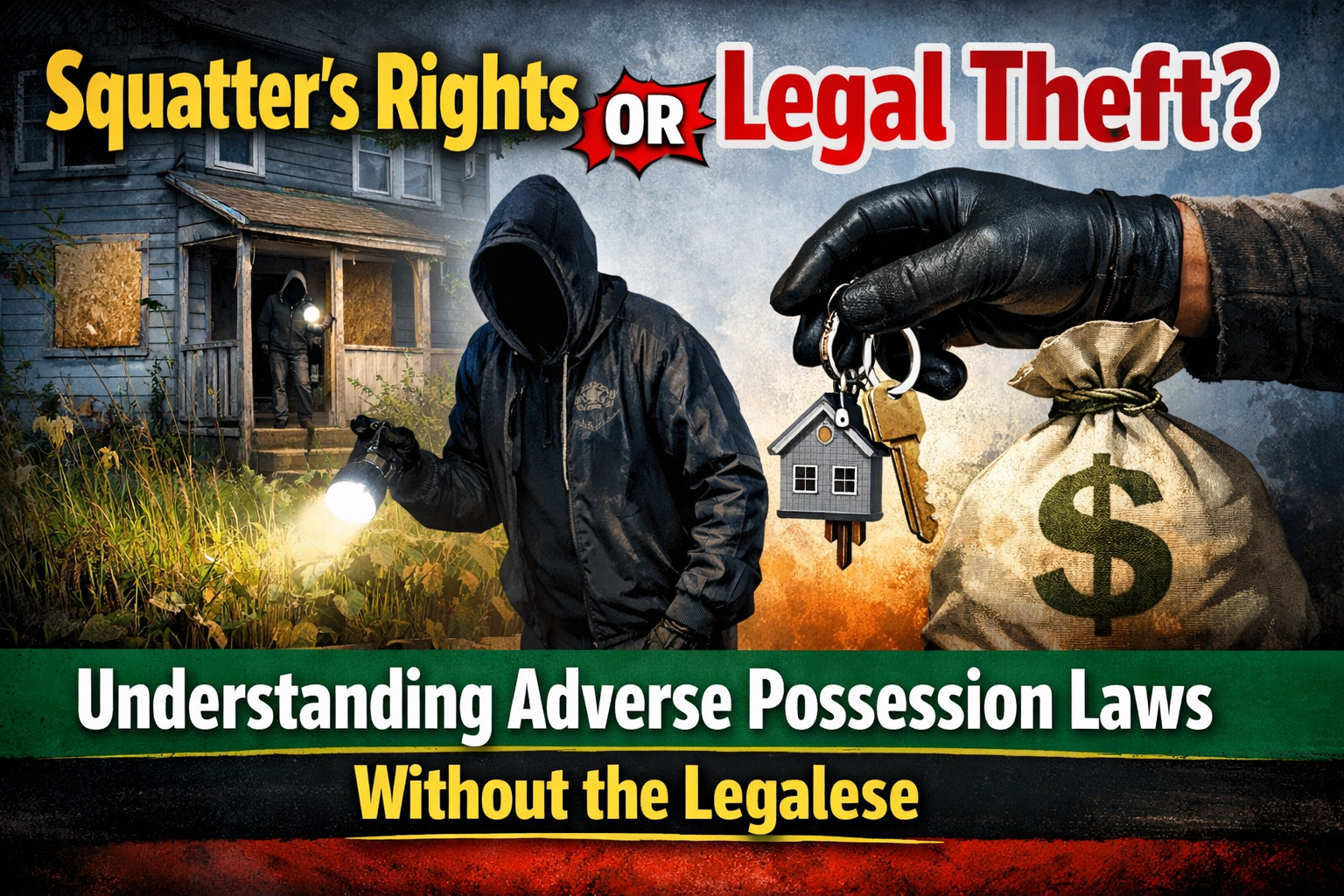
Worried about squatters taking your land? We decode adverse possession laws, explaining how “squatter’s rights” actually work and how to protect your property title.
Table of Contents
I once got a frantic call from a client named “Tom.” Tom had inherited a few acres of woodland from his grandfather in rural Pennsylvania. He hadn’t visited the property in about 15 years. When he finally drove out there to survey it for sale, he found a surprise.
His neighbor had built a shed on it. And not just a shed—a garden, a fence, and a chicken coop.
“I told him to get off my land!” Tom yelled into the phone. “And he told me he owns it now because he’s been mowing it since 2005!”
Tom was dealing with the terrifying reality of adverse possession laws. To most people, this concept sounds like legalized theft. How can someone just take your land because they used it? But in the eyes of the law, it’s not theft; it’s about efficient land use. The legal system hates wasted land. If you ignore your property and someone else puts it to good use for long enough, the state might just hand them the deed.
It sounds crazy, but it happens more often than you think. Whether you are an absentee landowner, a real estate investor, or just a homeowner with a confusing fence line, you need to understand how adverse possession laws work. Let’s break down the scary myths and the actual legal requirements so you don’t end up like Tom.
What Actually Is Adverse Possession?
Let’s strip away the Latin. Adverse possession laws are a set of statutes that allow a trespasser to gain legal title to a property if they occupy it for a specific period of time.
This isn’t just about squatters breaking into an empty house (though that grabs the headlines). It’s often much more subtle. It’s the neighbor who builds their driveway three feet over your property line. It’s the farmer who has been planting corn on the “back 40” acres that actually belongs to the guy next door.
If you don’t catch them and stop them, eventually, that land becomes theirs. The clock is always ticking. The logic behind adverse possession laws is to encourage property owners to actively manage and monitor their land. If you sleep on your rights, you lose them.
The 5 Pillars of a Claim
You can’t just sneak onto someone’s porch, sleep there for a night, and claim the house. To successfully claim title under adverse possession laws, a trespasser (the “dissector”) typically has to prove five specific things. If they miss even one, the claim fails.
1. Hostile Claim
“Hostile” doesn’t mean they are holding a pitchfork. In legal terms, it just means they are there without permission. If you tell your neighbor, “Sure, go ahead and plant tomatoes on my side of the fence,” they can never claim adverse possession. Why? Because you gave permission. Permission kills the “hostile” requirement instantly.
2. Actual Possession
They have to physically be there. They can’t just say they own it. They have to treat the land like a true owner would. This usually means making improvements—building a fence, mowing the grass, planting crops, or paying the taxes.
3. Open and Notorious
This is my favorite legal term. It means they aren’t hiding. Their use of the land must be so obvious that the real owner should have noticed it. If I build a secret underground bunker on your land that nobody can see, adverse possession laws won’t help me. But if I build a bright red barn in the middle of your field, that is “open and notorious.”
4. Exclusive Possession
The trespasser has to be the only one using it. They can’t share it with the public or with the true owner. If Tom (from my story) had gone camping on his land every summer, the neighbor’s claim would likely fail because the possession wasn’t exclusive.
5. Continuous Possession
They can’t leave. They have to occupy the land continuously for the entire statutory period. If they leave for a year and come back, the clock resets to zero.
The “Clock”: How Long Does It Take?
This is where adverse possession laws vary wildly by state. The “statutory period” is the amount of time the trespasser must occupy the land before they can file a claim.
- California: 5 years (but they must pay property taxes).
- Texas: varies (3 to 25 years depending on the paperwork).
- New York: 10 years.
- Pennsylvania: 21 years.
Tom was lucky. In Pennsylvania, the clock is 21 years. His neighbor had only been there for 15. Tom was able to file an ejectment action and kick the neighbor (and his chickens) off the land. But if he had waited another six years? He would have lost those acres forever.
Link to Cornell Law School: Adverse Possession Overview
The “Color of Title” Loophole
There is a weird twist in adverse possession laws called “Color of Title.” This happens when someone thinks they own the land because of a bad deed or a mistake in the paperwork. Maybe they bought a house, and the deed said it included the backyard, but the legal description was wrong.
If a trespasser has “Color of Title,” the statutory period is often much shorter. For example, in some states, a squatter needs 20 years to claim land. But if they have a faulty deed (Color of Title), they might only need 7 years. The law is more lenient when the person genuinely believes they are the owner.
Paying the Taxes: The Ultimate Proof
In many states (like California, Florida, and Texas), adverse possession laws have a huge hurdle: Property Taxes. To win a claim, the trespasser often has to prove they paid the county property taxes on that specific piece of land for the entire statutory period.
This is a massive barrier. Most squatters aren’t running down to the county assessor to pay someone else’s tax bill. However, for boundary disputes (like the neighbor’s fence), this gets tricky. The neighbor is paying taxes on their lot, but if the fence line is wrong, are they paying taxes on the disputed strip? Lawyers make a lot of money arguing over this specific point.
How to Protect Your Property
If you own land, you are a target. Especially if it’s vacant land or a vacation home you rarely visit. Here is how to use your knowledge of adverse possession laws to defend your turf:
1. Inspect Your Property: Walk the perimeter at least once a year. Look for new trails, deer stands, fences, or trash. If you see something, say something.
2. Post “No Trespassing” Signs: It sounds simple, but it establishes that the use is non-consensual. It helps defeat the “good faith” argument some states require.
3. Grant Permission: If your neighbor’s driveway is over the line and you don’t want to start a war, just give them written permission. “Dear Neighbor, I acknowledge your driveway is on my land. I am giving you a revocable license to keep it there.” By giving permission, you strip away the “hostile” element of adverse possession laws. It protects your title while keeping the peace.
4. Check Your Survey: When you buy a house, don’t just look at the fence. Fences are often wrong. Look at the survey pins. If the fence is five feet inside your property line, you are effectively donating that strip to your neighbor if you don’t correct it.
Link to FindLaw: State-by-State Adverse Possession Laws
Can You Fight It?
Yes. If someone files a “Quiet Title” action claiming they own your land under adverse possession laws, you have to fight back immediately. This is called an Action to Quiet Title. You go to court and prove:
- “I gave them permission.”
- “They weren’t there for 10 years; they were only there for 5.”
- “I used the land too (breaking exclusivity).”
It is expensive. A quiet title lawsuit can cost $5,000 to $20,000 in legal fees. But losing the land costs more.
Conclusion
The concept of “Squatter’s Rights” feels unjust. We are taught that if we buy something, it’s ours forever. But adverse possession laws are a reminder that ownership is an active responsibility, not a passive right.
The law rewards those who use land and punishes those who neglect it. So, take a lesson from Tom. Go visit that vacant lot. Walk your fence line. Say hi to the neighbors (and check where their shed is). Because the only thing worse than paying property taxes is paying property taxes on land you no longer own.
Have you ever had a boundary dispute with a neighbor? Did they try to claim the land was theirs? Tell me your story in the comments below!
FAQ Section
1. Can a tenant claim adverse possession? Generally, no. A tenant is there with permission (a lease). Remember, adverse possession laws require “hostile” use. As long as they are paying rent—or even if they stop paying rent but haven’t been evicted—their possession is usually considered permissive, preventing a claim.
2. Does a fence line determine ownership? Not automatically, but over time, yes. If a fence is placed incorrectly and stands for the statutory period (e.g., 20 years), the boundary line can legally shift to the fence line under the doctrine of “boundary by acquiescence” or adverse possession.
3. Can I claim adverse possession on government land? Nice try, but no. You generally cannot claim adverse possession laws against the government. You can camp in a National Park for 50 years, and you will never own it. The government is immune to these claims.
4. What is a “Quiet Title” action? This is a lawsuit filed to settle a dispute over who owns a piece of property. If you succeed in an adverse possession claim, the judge issues a court order “quieting” the title, effectively erasing the old owner’s name and writing yours on the deed.
5. Do I need a lawyer to claim adverse possession? Yes. You definitely should. The burden of proof is very high. You need to prove all five elements with clear and convincing evidence. Navigating the nuances of your state’s adverse possession laws without an attorney is a recipe for failure.
6. Is squatting the same as adverse possession? Squatting is the act; adverse possession is the legal result. A squatter is a trespasser. If that squatter stays long enough and meets all the legal criteria of adverse possession laws, they can transform from a criminal trespasser into a legal owner. But until that clock runs out, they are just a trespasser.