
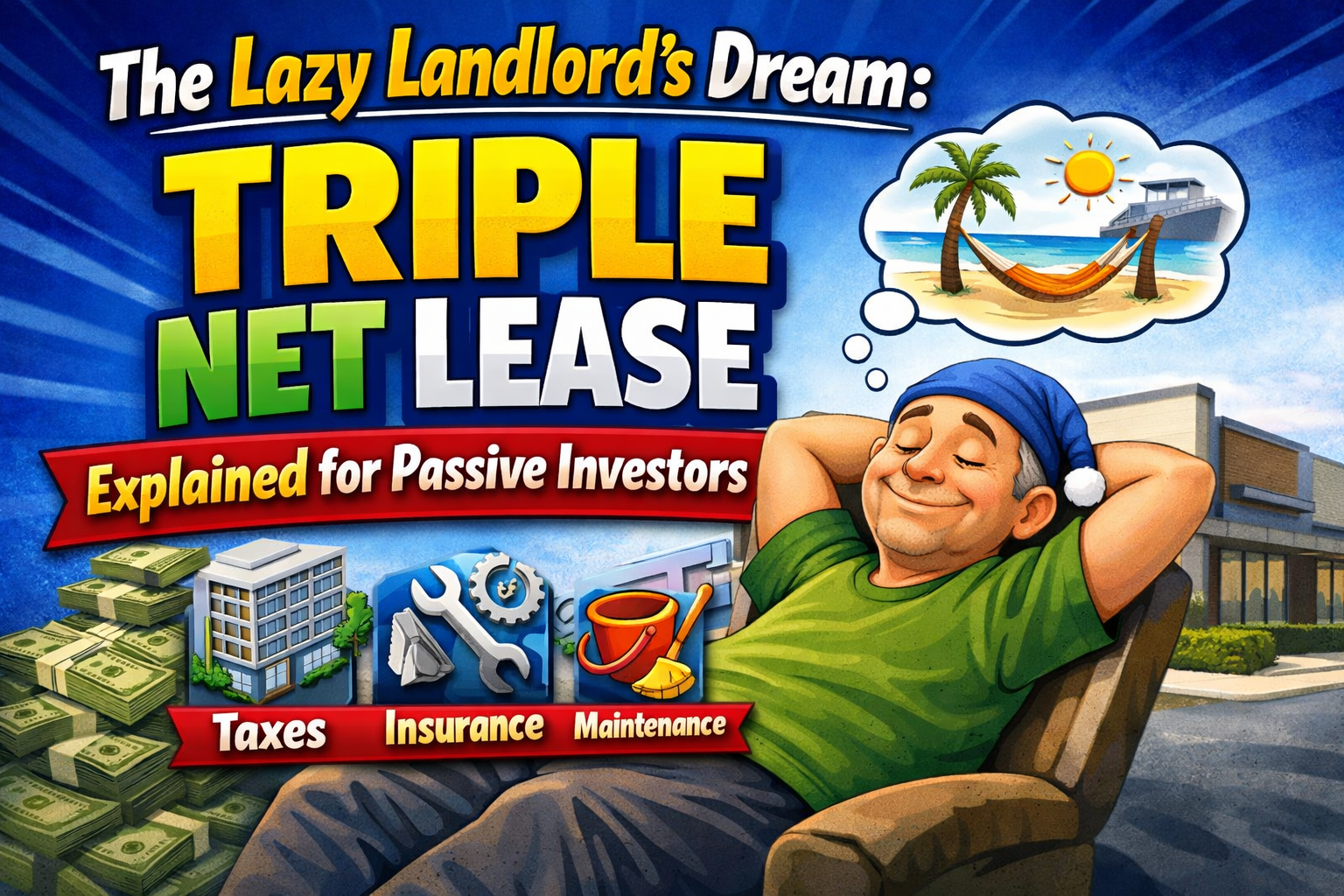
Tired of 2 AM toilet calls? A triple net lease might be your exit strategy. Learn why smart money loves these hands-off commercial deals and how they work.
Table of Contents
I started my real estate career like most people: buying a beat-up duplex in a working-class neighborhood. I thought I was a genius. I had cash flow! I was building equity! Then, three months in, a tenant called me on Thanksgiving Day to tell me the water heater had exploded. I spent my holiday mopping up a basement instead of eating turkey.
That was the day I started looking for a better way. I realized that while residential real estate is great for getting started, it is terrible for your free time. Eventually, I stumbled upon the holy grail of passive investing: the triple net lease.
If you are sick of dealing with leaky roofs, rising property taxes, and tenants who treat your property like a landfill, you need to understand this concept. It is the specific lease structure that allows billionaires and institutional funds to own massive portfolios without ever picking up a hammer. Let’s break down exactly how a triple net lease works, why it’s the gold standard for commercial investors, and if it’s the right move for your portfolio.
What on Earth is a Triple Net Lease?
In the world of commercial real estate, not all rent checks are created equal. Most residential leases are “Gross Leases.” You pay the landlord $1,500 a month, and the landlord pays the taxes, the insurance, and the maintenance. If the tax bill goes up, the landlord makes less money.
A triple net lease (often abbreviated as NNN) flips this script entirely. In this arrangement, the tenant agrees to pay the base rent plus the three big expenses of property ownership:
- Net Real Estate Taxes
- Net Building Insurance
- Net Common Area Maintenance (CAM)
Basically, the tenant pays for everything. If the city raises property taxes? The tenant pays it. If the parking lot needs to be repaved? The tenant pays it. If the roof leaks? In a true absolute net deal, the tenant fixes it.
When you own a property with a triple net lease, your rent check is pure profit (Net Operating Income). You aren’t guessing what your expenses will be next year because you don’t have any.
Why Investors are Obsessed with NNN
The allure is simple: predictability. When I analyze a residential deal, I have to estimate a “maintenance reserve.” I have to guess how much insurance will rise. With a triple net lease, the risk is transferred to the tenant.
Imagine owning a building leased to Walgreens or Starbucks. These are “creditworthy tenants.” They sign 15 or 20-year leases. They don’t just pay the rent; they maintain the building to their corporate standards. You just collect the check. It is the closest thing to a bond you can find in the real estate world, but with the tax benefits of owning physical dirt.
Link to Investopedia: Triple Net Lease (NNN) Definition
The “N” Breakdown: Who Pays What?
Let’s dig a little deeper into those three “N”s, because the devil is in the details.
1. Property Taxes
In a triple net lease, the tenant pays the property taxes directly to the municipality (or reimburses you). This is huge. Commercial property taxes can jump wildly when a property is sold. In a gross lease, that jump eats your profit. Here, the tenant absorbs it.
2. Insurance
The tenant carries the policy. If there is a fire or a slip-and-fall lawsuit in the lobby, it’s on their insurance, not yours. You simply verify they have the coverage.
3. Maintenance (CAM)
This is where disputes happen. “Common Area Maintenance” covers landscaping, snow removal, trash, and exterior lights. In a shopping center with multiple tenants, everyone pays their “pro-rata share” based on square footage.
Absolute Net vs. Double Net (NN)
Be careful. Not every commercial deal is a pure triple net lease. Brokers love to throw the term around loosely. You will often see “Double Net” (NN) leases. In a Double Net deal, the tenant pays taxes and insurance, but the landlord is responsible for the roof and structure. I’ve seen investors get burned thinking they had a hands-off deal, only to get hit with a $50,000 bill for a new roof on a warehouse.
The “Holy Grail” is the Absolute Net Lease. This is usually a single tenant (like a Taco Bell or a bank branch). They are responsible for everything—roof, structure, foundation. You literally do nothing but deposit the check. These deals command a premium price because they are truly passive.
The Risks: It’s Not All Sunshine
If a triple net lease is so perfect, why doesn’t everyone buy one? Because the stakes are higher.
1. Vacancy kills you. If you own a 4-plex and one tenant moves out, you still have 75% of your income. If you own a single-tenant NNN building and that tenant goes bankrupt (remember Blockbuster?), you have 0% income. And you still have to pay the taxes and insurance yourself until you find a new tenant.
2. Re-Leasing Costs. Finding a commercial tenant isn’t like finding a roommate on Craigslist. It can take 6 to 12 months. And the new tenant might demand $100,000 in “Tenant Improvement” (TI) allowances to build out their space.
3. Lower Returns (Cap Rates). Because a triple net lease is safer and easier, it pays less. You might get a 5% or 6% return (Cap Rate) on a McDonald’s building. You might get an 8% or 10% return on a messy apartment complex where you manage the toilets. You pay for the convenience with lower yield.
Link to LoopNet: Guide to NNN Leases
Who is the Ideal Buyer?
I usually see two types of buyers chasing the triple net lease strategy:
1. The 1031 Exchange Investor This is the boomer who has owned a 20-unit apartment building for 30 years. They are tired. They want to retire. They sell the apartments for $2 million and use a 1031 tax-deferred exchange to buy a CVS pharmacy with a triple net lease. They trade high-maintenance cash flow for low-maintenance stability.
2. The High-Net-Worth Professional Doctors, lawyers, and tech workers who have cash but zero time. They want real estate exposure but can’t leave surgery to fix a furnace. They buy NNN properties as a place to park capital that beats the stock market volatility.
Negotiating the Lease (Don’t Try This Alone)
If you are entering this arena, get a shark of a lawyer. Commercial leases are 50-page documents. You need to define exactly what constitutes “structural maintenance.” Does the HVAC replacement fall on the tenant or the landlord? In a true triple net lease, it should be the tenant. But corporate tenants have powerful legal teams who try to shift that cost back to you.
I worked with a client who bought a strip mall. The lease said the tenant paid for “maintenance” of the HVAC but the landlord paid for “replacement.” Guess what happened? The units were old. The tenants refused to fix them and just waited for them to die so the landlord had to buy new ones. A better lease clause would have saved him $30,000.
Is It Right for You?
Ask yourself: Do you want a job, or do you want an investment? If you are young, hungry, and have little capital, stick to residential. You can force appreciation by fixing up kitchens. But if you have significant capital ($500k+) and want to protect your wealth, a triple net lease is a fortress.
It allows you to own tangible assets without the headache of operations. It scales infinitely. You can own 50 Burger Kings easier than you can own 50 rental houses.
Conclusion
The transition from residential landlord to commercial investor is a journey. It requires a mindset shift. You stop looking at the condition of the carpet and start looking at the credit rating of the tenant. A triple net lease offers a unique blend of security and passivity that is hard to beat.
Yes, the returns might be slightly lower on paper. But when you factor in the value of your time—no Thanksgiving emergency calls, no eviction courts, no painting weekends—the real ROI is often much higher. If you are ready to trade your plunger for a portfolio, it might be time to start looking for your first NNN deal.
Have you ever considered moving your equity into commercial property? Or do you prefer the control of residential rentals? Let me know in the comments below!
FAQ Section
1. What happens if the tenant stops paying taxes in a triple net lease? This is a major risk. Even though the lease says they must pay, the county will come after you (the owner) if they don’t. This is why you must monitor them. Many landlords collect the tax money monthly and pay it themselves (escrow) just to be safe.
2. Are NNN leases only for big chains like Starbucks? No. You can have a triple net lease with a local dentist, a law firm, or a mechanic shop. However, the value of the property is heavily tied to the strength of the tenant. A lease with “Joe’s Coffee” is worth less to a future buyer than a lease with Starbucks, even if the rent is the same.
3. Do I need an LLC to buy these? Technically no, but practically yes. You should almost always hold commercial assets in an LLC for liability protection. If someone gets hurt on the property and sues, you want to protect your personal assets.
4. How long are these leases usually? They are long. A standard triple net lease for a retail tenant is usually 5, 10, or even 20 years. This provides stability, but it can also lock you in. If market rents double in 5 years, you might be stuck collecting the old, lower rent until the lease expires.
5. Can I finance a triple net property? Yes. Lenders love these deals because the income is stable. You can often get commercial loans with 25% to 35% down. However, the loan terms are usually shorter (5 to 10 years) compared to the 30-year mortgages in residential real estate.
6. What is a “Sale-Leaseback”? This is a common way to create a triple net lease. A business (like a dentist) owns their own building. They sell it to an investor (you) and immediately sign a long-term lease to rent it back. They get cash to expand their business; you get a stable tenant from day one.