
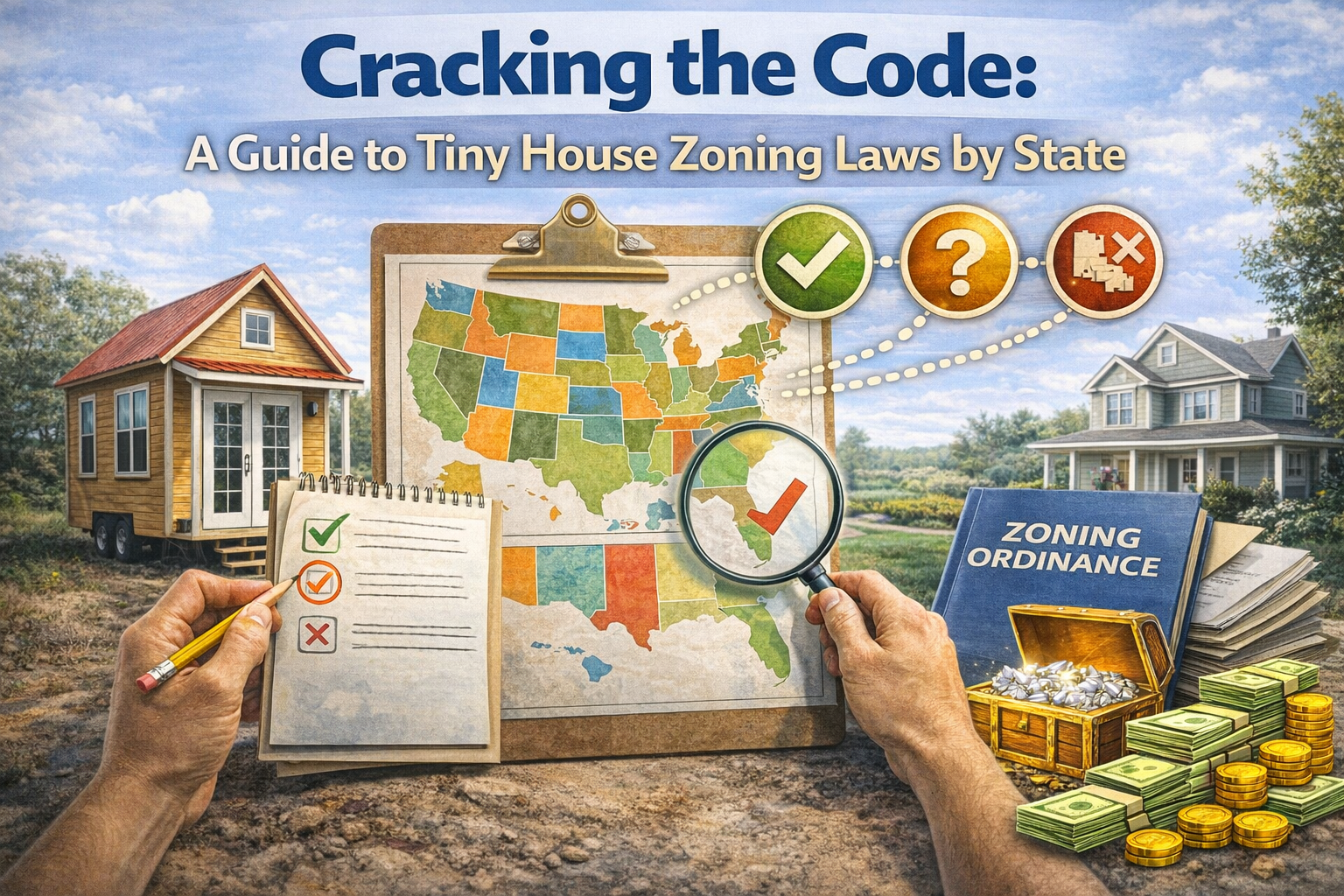
Dreaming of going small? Before you build, you need to understand Tiny House Zoning Laws. Learn how local ordinances impact where you can legally park or build.
Table of Contents
I had a client last year—let’s call her Sarah—who bought a gorgeous, custom-built 300-square-foot home on wheels. She spent her entire savings on it. She planned to park it on a beautiful plot of land she bought in upstate New York. Two weeks after she moved in, the county slapped her with a notice of violation. Sarah didn’t understand Tiny House Zoning Laws, and it almost cost her everything.
The tiny home movement is romanticized on TV, but the reality is tangled in red tape. City planners and local governments are still struggling to classify these structures. Are they RVs? Are they accessory dwelling units? Are they mobile homes? The answer depends entirely on your zip code.
If you are a buyer, investor, or just someone looking to downsize, navigating Tiny House Zoning Laws is the single most important step in your journey. Forget the composting toilets and the clever storage stairs for a minute; if you can’t legally put your house on the land, nothing else matters. Let’s break down the legal landscape so you can build your dream without the nightmare.
What Exactly Are Tiny House Zoning Laws?
Before you buy a piece of land, you need to separate building codes from zoning. Building codes dictate how a structure is built (safety, electrical, plumbing). Tiny House Zoning Laws, on the other hand, dictate where a structure can be placed and how the land is used.
Local ordinances establish rules for every piece of dirt in a municipality. They regulate:
- Minimum square footage: Many residential zoning areas require a primary residence to be at least 1,000 square feet. This instantly outlaws a 400-square-foot tiny home.
- Land use regulations: Can the lot have more than one dwelling?
- Setbacks: How far the house must be from the property line.
When you research Tiny House Zoning Laws, you are basically asking the city, “Will you allow this specific type of structure on this specific piece of land?”
The Foundation vs. Wheels Debate
The biggest dividing line in Tiny House Zoning Laws is whether your home has a permanent foundation or sits on a chassis with wheels (THOW – Tiny House on Wheels).
Tiny Houses on a Foundation
If you build on a foundation, most municipalities classify the structure as an Accessory Dwelling Unit (ADU) or a standard single-family home (if it meets the minimum size requirements). Building an ADU is becoming much easier in progressive states. You will need to pull building permits, establish utility hookups, and eventually secure a certificate of occupancy.
Tiny Houses on Wheels (THOW)
This is where it gets incredibly tricky. Most Tiny House Zoning Laws classify a THOW as a Recreational Vehicle (RV). Why is that a problem? Because in the vast majority of US counties, it is illegal to live in an RV full-time as a primary residence outside of a designated RV park. You can’t just park it in a suburban backyard and move in permanently.
The Most Friendly States for Tiny House Zoning Laws
Because zoning is usually handled at the city or county level, there is no blanket federal law. However, some state legislatures have stepped in to mandate that local municipalities relax their rules. If you are looking for the path of least resistance, here are the states leading the charge in reforming Tiny House Zoning Laws:
1. California
California is the undisputed king of the ADU. Due to the severe housing shortage, the state passed laws overriding local residential zoning to allow ADUs on almost all single-family lots. Furthermore, cities like Los Angeles and San Jose have specifically updated their Tiny House Zoning Laws to allow THOWs in backyards as legal, full-time dwellings.
2. Colorado
Colorado has a strong off-grid living culture. Towns like Walsenburg and Durango were some of the first in the nation to drop their minimum square footage requirements to accommodate tiny homes. El Paso county allows them in certain unincorporated areas, making it a hotspot for tiny home investors.
3. Texas
Texas is famous for its lack of state-level zoning interference, leaving it up to local jurisdictions. While big cities have strict building codes, places like Spur, Texas, have branded themselves as the first tiny-house-friendly town in America. As long as you meet basic HUD standards for safety, you are welcome.
4. Oregon
Portland, Oregon, has long been a pioneer. They recognize tiny houses as legitimate dwelling units and have adapted their local ordinances to allow them to be used as primary residences or backyard ADUs with relatively low permit fees.
How to Check the Rules in Your Area
Don’t buy land based on a Google search. The regulations change block by block. Here is the practical way to verify the rules before you invest:
- Call the Zoning Office: Go straight to the source. Call your county or city planning and zoning department.
- Ask About Minimums: Ask, “Is there a minimum square footage requirement for a primary dwelling on this parcel?”
- Ask About ADUs: If you are putting it in a backyard, ask about their Accessory Dwelling Unit policies.
- Deed Restrictions and HOAs: Even if the city says yes, a Homeowner’s Association (HOA) can say no. Always check the deed restrictions for the specific neighborhood.
Link to American Planning Association: Land Use and Zoning Basics
Overcoming the Hurdles: Variances and Planned Communities
If the local Tiny House Zoning Laws are strictly against you, you have two options.
First, you can apply for a variance. A variance is a special exception granted by the city council or zoning board. You will have to attend a public hearing, explain your case, and likely face opposition from neighbors worried about property taxes and neighborhood character. It is an uphill battle, but not impossible.
Second, look for a planned tiny home community. Because of the legal headaches, developers are buying large tracts of commercial or RV-zoned land and creating dedicated tiny house neighborhoods. You rent or buy the “pad” (which already has utility hookups), and the zoning is already legally established for your home.
Link to National Association of Home Builders: ADU and Tiny Home Resources
Conclusion
The tiny house movement is more than just an architectural trend; it is a direct response to the affordable housing crisis. However, the legal system moves much slower than the housing market.
Before you hire a builder or buy a trailer, you must do your due diligence. Understanding your local Tiny House Zoning Laws is the difference between living peacefully in your debt-free dream home and fighting a stressful, expensive legal battle with your county.
Do the research, talk to the local planners, and ensure your tiny home is on solid legal ground—whether it has wheels or not.
Have you run into issues with zoning restrictions in your area? Drop a comment below and let me know which state you are trying to build in!
FAQ Section
1. Are Tiny House Zoning Laws the same everywhere in a state? No. While some states (like California) have state-wide mandates regarding ADUs, the vast majority of Tiny House Zoning Laws are written and enforced at the local city or county level. What is legal in one county might be completely illegal five miles away in the next county.
2. Can I live in a tiny house in my backyard? It depends on how the house is built and local land use regulations. If it is on a foundation, it is usually considered an Accessory Dwelling Unit (ADU) and is allowed in many cities. If it is on wheels, most cities currently classify it as an RV and prohibit full-time living, though this is slowly changing.
3. Do I have to pay property taxes on a tiny house? If your tiny house is built on a permanent foundation, it is considered real estate, and it will increase your assessed property value, leading to property taxes. If it is on wheels, it is typically considered personal property (like a vehicle) and is subject to personal property taxes or DMV registration fees, not real estate taxes.
4. What is the difference between a tiny house and a manufactured home? Manufactured homes (mobile homes) are built in factories and must adhere strictly to federal HUD standards. Tiny houses are often custom-built and might follow standard residential building codes, RV codes (like NOA/RVIA certification), or no codes at all, which is why local zoning offices struggle to classify them.
5. How do I get a certificate of occupancy for a tiny house? You must pull all the necessary building permits before construction, pass various inspections (foundation, electrical, plumbing) during the build, and ensure the structure meets local building codes. Once the final inspection is passed, the local building department will issue the certificate of occupancy, making it legally habitable.
6. Can I build a tiny house totally off-grid? Even if you use solar panels and composting toilets, local zoning rules and building codes often require properties to be connected to municipal water and sewer lines to be legally habitable. Always check with the local health department regarding off-grid waste management.