

Forget luxury condos. The real money is in the gritty world of Urban Logistics Real Estate. Learn why investors are fighting over “last-mile” warehouses to power the e-commerce boom.
Table of Contents
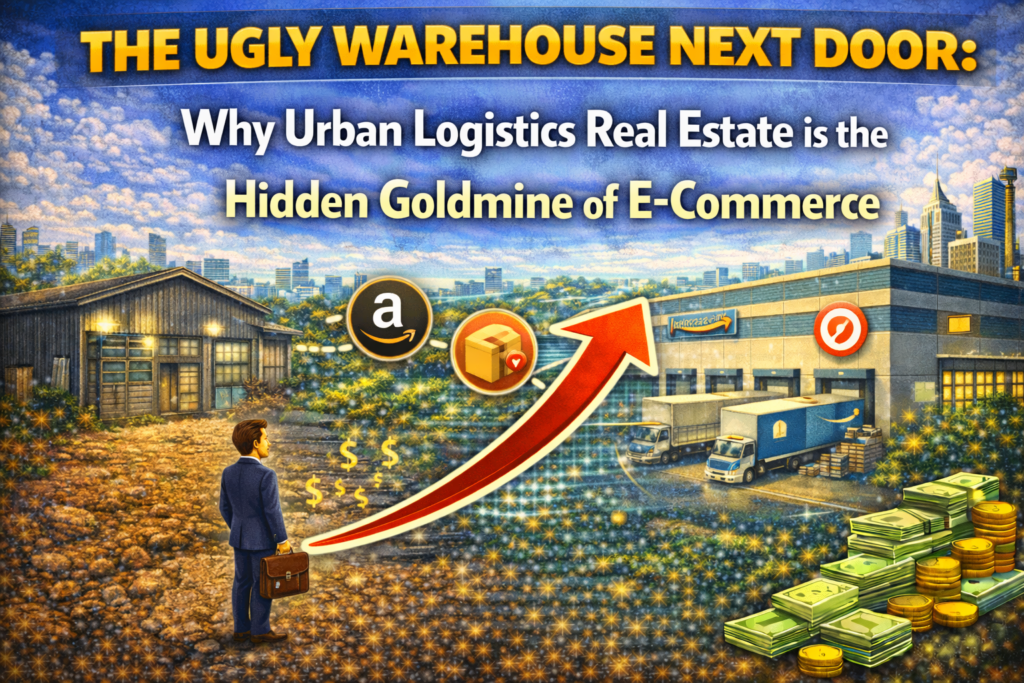
I was stuck in traffic in downtown Los Angeles a few months ago, right next to an old, beat-up auto repair shop. It was an eyesore—peeling paint, chain-link fence, the works. But then I noticed something strange.
A fleet of shiny blue electric vans was buzzing in and out of the bay doors like bees at a hive.
That wasn’t a repair shop anymore. It had been quietly converted into a micro-fulfillment center. That crumbling building was likely generating more revenue per square foot than the fancy coffee shop across the street.
This is the invisible revolution happening in our cities. While everyone is distracted by flashy high-rise apartments and mixed-use developments, the smart money is pouring into Urban Logistics Real Estate. It’s not sexy. It’s not glamorous. But it is the absolute backbone of the modern economy.
If you’ve ever wondered how your Amazon package arrives four hours after you ordered it, the answer lies in these unassuming buildings. For investors and landlords, Urban Logistics Real Estate represents a “hidden goldmine” that is reshaping the commercial market. Let’s peel back the corrugated metal layers and see why this sector is outperforming almost everything else.
The “Amazon Effect” and the Need for Speed
We have become a society of instant gratification. Ten years ago, waiting five days for shipping was normal. Today? If it’s not there by tomorrow, we cancel the order. This shift in consumer behavior has broken the old supply chain model.
Historically, companies stored goods in massive distribution centers in the middle of nowhere—places where land was cheap. But you can’t deliver a toothbrush to a customer in downtown Chicago in two hours if your warehouse is in a cornfield in Iowa. You need to be close. You need to be in the city.
This creates a desperate demand for Urban Logistics Real Estate. Retailers are scrambling to find “infill” locations—smaller warehouses, old factories, or even repurposed retail spaces—that sit within the “last mile” of the consumer. The “last mile” is the most expensive part of shipping (often 50% of the total cost). By securing Urban Logistics Real Estate right next to high-density neighborhoods, companies slash that cost and speed up delivery.
What Does This Real Estate Look Like?
When you picture “industrial real estate,” you probably think of a massive 500,000-square-foot box. Urban Logistics Real Estate is different. It’s scrappy.
It typically looks like:
- Class B or C Industrial Buildings: Older warehouses with lower ceilings (18-24 feet) that were previously ignored by big investors.
- Size: Usually smaller, ranging from 20,000 to 100,000 square feet.
- Location: Gritty neighborhoods, near highway off-ramps, or tucked behind residential zones.
I helped a client recently who was looking for a “flex space” to lease to a grocery delivery startup. They didn’t care about curb appeal. They cared about loading docks and proximity to the highway. They paid 20% over asking price because the location saved them thousands in fuel costs.
Adaptive Reuse: Turning Malls into Warehouses
Here is where it gets creative. Cities are running out of industrial land. You can’t just build a new warehouse in the middle of Manhattan or San Francisco. The zoning won’t allow it, and the land is too expensive. So, developers are getting inventive with Urban Logistics Real Estate.
We are seeing “Adaptive Reuse” on a massive scale.
- Dead Malls: Old department stores (like Sears or JCPenney) are being gutted and turned into fulfillment centers. They have high ceilings and loading docks—perfect for logistics.
- Parking Garages: With ride-sharing reducing the need for parking, some underground garages are being converted into “dark stores” for grocery delivery.
It sounds dystopian to some, but to a real estate investor, it is pure efficiency. It turns a distressed asset (a dead mall) into a high-demand asset (Urban Logistics Real Estate).
Link to Prologis: The Future of Urban Logistics
The Investment Case: Cap Rates and Stability
Why should you care? Because the returns are solid. In commercial real estate, we look at “Cap Rates” (Capitalization Rates). While cap rates for office buildings are shaky due to remote work, and retail is volatile, industrial cap rates have compressed—meaning values have skyrocketed.
Urban Logistics Real Estate offers a defensive play. Even in a recession, people buy toothpaste and diapers online. The tenant demand is incredibly “sticky.” Once a logistics company installs their conveyor belts and sorting robots, they aren’t going to move out next year to save a few pennies on rent. They sign long leases—often 5, 7, or 10 years. For a landlord, that stability is better than gold. It’s boring, reliable cash flow.
The Challenges: Zoning and NIMBYs
I have to give you the bad news too. Buying or developing Urban Logistics Real Estate is a headache. The biggest hurdle is the neighbors. Nobody wants a fleet of delivery trucks rumbling past their bedroom window at 6 AM. This is the “NIMBY” (Not In My Backyard) factor.
Cities are fighting back against the encroachment of industrial use into residential areas. If you are looking to invest in Urban Logistics Real Estate, you need to be a zoning expert.
- Can you legally run 24/7 operations?
- Are there noise ordinances?
- Are there weight limits for trucks on the local streets?
I’ve seen deals fall apart because the investor didn’t realize the street was zoned to prohibit vehicles over 3 tons. Do your homework.
The Vertical Future: Multi-Story Warehouses
Since we can’t build out, we have to build up. In Asia (places like Hong Kong and Tokyo), multi-story warehouses are common. Trucks drive up spiral ramps to the second or third floor to load. This trend is finally hitting the US. We are seeing the first multi-story Urban Logistics Real Estate projects popping up in Seattle and New York.
It’s expensive to build (you need incredibly strong concrete floors), but when land is $100 per square foot, it makes sense. This vertical integration is the next frontier. If you can find a site that supports a multi-story industrial build, you are sitting on a lottery ticket.
Who are the Tenants?
It’s not just Amazon. If you own a piece of Urban Logistics Real Estate, your tenant pool is diverse.
- 3PLs (Third Party Logistics): Companies like DHL or FedEx that handle shipping for other brands.
- DTC (Direct to Consumer) Brands: Mattress companies, meal kit services (like HelloFresh), and furniture startups.
- Construction Supply: With the building boom, construction companies need urban depots for lumber and drywall closer to the job sites.
Diversification is key. You don’t want to be solely reliant on one giant tech company. A building that can be split into three smaller units is often safer than one giant box.
Link to JLL: Urban Logistics and the Last Mile
How to Get Started
You don’t need $50 million to enter this space. While the big institutional players (like Blackstone) are buying huge portfolios, there is plenty of room for the small investor in the “Light Industrial” sector. Look for:
- Old Auto Body Shops: These often have the roll-up doors and zoning you need.
- Small Flex Condos: You can buy individual industrial condos in a larger park.
- Distressed Retail: Look for strip malls with rear alley access that can be converted.
Don’t look for pretty. Look for utility. Does it have high amps (power)? Does it have a tall ceiling? Is it near the highway? If the answer is yes, you have a potential Urban Logistics Real Estate winner.
Conclusion
The way our cities function is changing. The “shop” is moving from the street corner to the server farm, and the “back room” is moving to the neighborhood warehouse. Urban Logistics Real Estate is the physical manifestation of the digital economy.
It’s gritty, it’s industrial, and it’s often ugly. But when I look at those blue vans buzzing out of that old repair shop, I don’t see an eyesore. I see the future of real estate revenue. If you are tired of chasing tenants in high-maintenance residential units, maybe it’s time to trade the marble countertops for concrete floors.
Do you have an old industrial building in your neighborhood that’s suddenly busy? Let me know in the comments—I’d love to hear how “last mile” is looking in your city!
FAQ Section
1. What is “Last Mile” delivery? The “Last Mile” refers to the final step of the shipping process—moving the package from a local distribution hub to the customer’s doorstep. It is the most expensive and time-consuming part of the supply chain, which is why Urban Logistics Real Estate located close to customers is so valuable.
2. Are these warehouses noisy? They can be. This is why zoning is critical. Operations involving heavy trucks, backup beepers, and loading dock activity can create significant noise pollution. Many cities impose “quiet hours” or require sound walls for facilities near residential zones.
3. Is this distinct from self-storage? Yes. Self-storage is for individuals to store their personal junk. Urban Logistics Real Estate is for businesses to store and distribute active inventory. However, we are seeing some hybrids where e-commerce sellers rent large self-storage units to run their businesses out of, blurring the lines.
4. Can I convert a house into a logistics hub? No. Residential zoning is very strict. You cannot run a commercial trucking operation out of a residential garage. You need “Commercial” or “Industrial” zoning. Trying to skirt this will result in hefty fines and a shutdown order from the city.
5. What is “Industrial Outdoor Storage” (IOS)? This is a sub-niche of Urban Logistics Real Estate. It refers to land used to store vehicles, trailers, or construction materials outside. It is becoming incredibly hot because Amazon fleets need places to park their vans overnight. It’s basically “parking lots for logistics.”
6. Why are ceiling heights important? Modern logistics relies on racking systems (stacking pallets high). A building with 12-foot ceilings is much less valuable than one with 24-foot ceilings because the tenant can store half as much stuff in the same footprint. In Urban Logistics Real Estate, vertical volume equals money.