
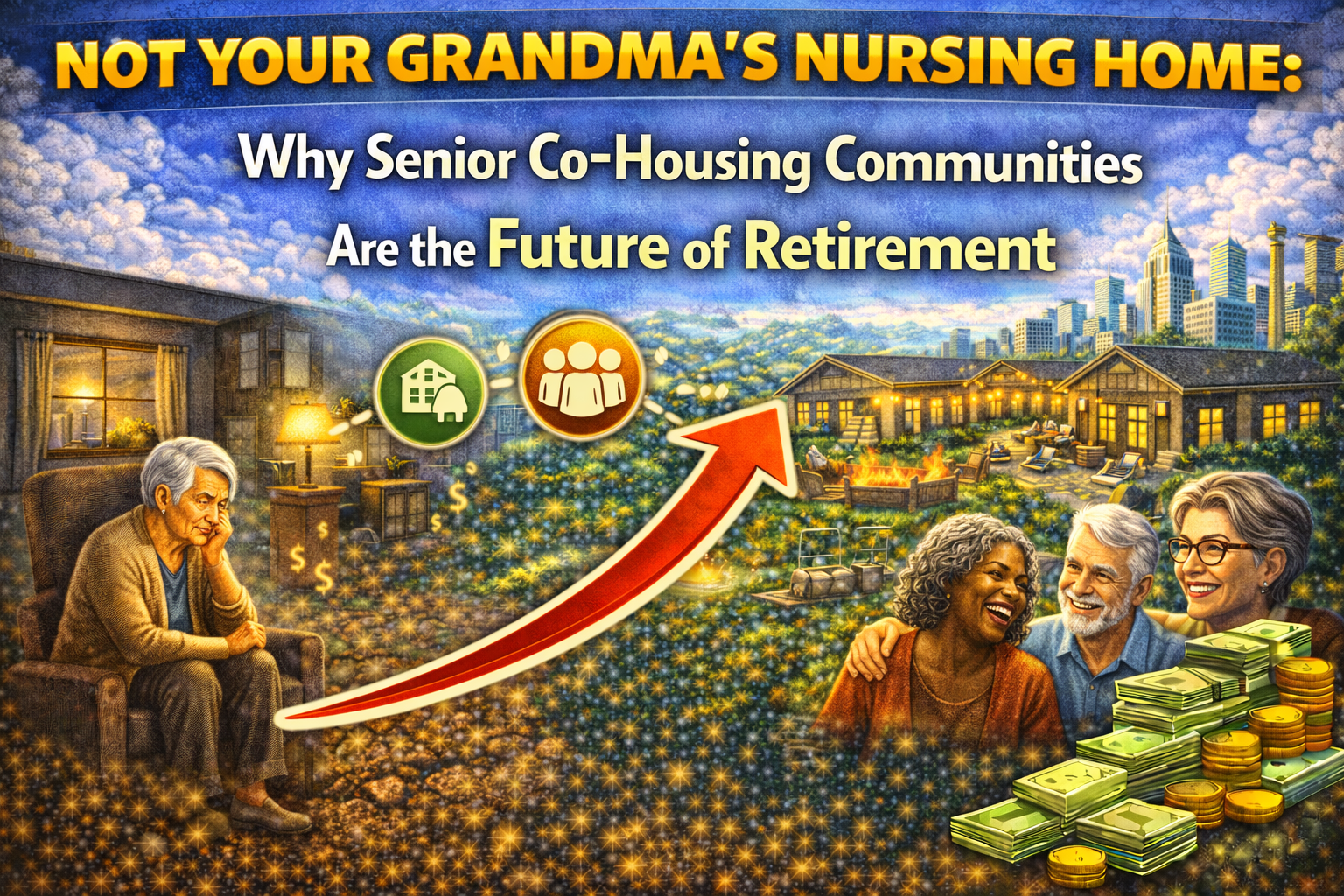
Dreading the idea of a retirement home? Senior Co-Housing Communities offer a vibrant, independent alternative. Discover how this social model beats loneliness and preserves your freedom.
Table of Contents
I spent last Tuesday afternoon with a client named “Barbara.” She is 72, sharp as a tack, and fiercely independent. She asked me to list her 4-bedroom suburban home, not because she couldn’t afford it, but because she couldn’t stand the silence.
“My kids are in Denver and Boston,” she told me. “I go days without speaking to a real person. But I refuse to go to ‘The Facility’ down the street where they serve mushy peas and play Bingo at 4 PM.”
Barbara’s dilemma is the crisis of her generation. We have built a world of big, isolated houses that work great for raising families but are terrible for aging alone. The solution she eventually found wasn’t an assisted living center; it was a spot in one of the new Senior Co-Housing Communities popping up on the edge of town.
If you haven’t heard of this concept, you aren’t alone. It is a niche that is rapidly moving mainstream. It’s basically the “Golden Girls” model come to life—private ownership mixed with intense social connection. For real estate investors and retirees alike, Senior Co-Housing Communities represent a radical rethink of what it means to grow old. Let’s explore why this model is catching fire and if it’s the right move for your golden years.
What Exactly Are Senior Co-Housing Communities?
Let’s clear up the misconceptions first. This isn’t a commune, and it definitely isn’t a nursing home. Senior Co-Housing Communities are neighborhoods consisting of private homes clustered around shared space.
Imagine a cul-de-sac where everyone actually knows each other.
- The Private Part: You own your own condo or cottage. You have a full kitchen, living room, and bedroom. It is your asset. You have a deed.
- The Shared Part: The “Common House.” This is the heart of the community. It usually has a massive commercial kitchen, a dining hall, guest suites for visiting grandkids, and maybe a workshop or art studio.
Residents in Senior Co-Housing Communities typically agree to eat dinner together a few times a week or share in the maintenance duties. It is “intentional community.” You aren’t just buying real estate; you are buying into a social contract to look out for your neighbors.
The Antidote to the “Loneliness Epidemic”
The Surgeon General recently declared loneliness a public health epidemic, stating it’s as dangerous as smoking. In a traditional retirement scenario, you age in place until you have a health crisis, and then you get moved to an institution. It is reactive and isolating.
Senior Co-Housing Communities are proactive. When I visited Barbara in her new setup a few months later, she was busy. She was on the “Landscape Committee” deciding where to plant hydrangeas. She had a potluck scheduled for 6 PM. “I have instant friends,” she said. “If I don’t open my blinds by 9 AM, someone knocks on my door to check on me. I feel safe.”
That informal safety net is the killer feature. It allows seniors to stay independent longer because they have a tribe around them. You don’t need to hire a nurse to check on you if your neighbor does it for free out of friendship.
Designing for “Aging in Place”
From a real estate perspective, these homes are built differently. Developers of Senior Co-Housing Communities almost always utilize Universal Design principles. This means:
- No steps at the front door (zero-entry).
- Lever door handles (easier for arthritic hands).
- Wide hallways for wheelchairs.
- Curbless showers.
Unlike retrofitting an old 1980s colonial, these homes are future-proofed. This is a huge selling point. Buyers know they won’t have to move again if their mobility declines. They can stay in their Senior Co-Housing Communities right up until the end, often bringing in home health aides if needed.
Link to The Cohousing Association of the US: What is Cohousing?
The Financial Picture: Is It Cheaper?
This is where it gets nuanced. Buying into Senior Co-Housing Communities is not necessarily “cheap” upfront. Because these are new construction, high-performance homes with extensive amenities (the Common House), the purchase price is often at or above market rate for the area.
However, the living costs are often lower.
- Shared Resources: You don’t need to own a lawnmower, a snowblower, or a ladder. The community owns one.
- Lower Utility Bills: Most are built to high energy-efficiency standards (LEED or Net Zero).
- Delayed Institutional Care: This is the big saving. If living in Senior Co-Housing Communities keeps you out of a $8,000/month assisted living facility for five extra years, you have saved nearly half a million dollars.
The Governance Challenge (It’s Not for Everyone)
I have to be honest—this lifestyle isn’t for the grumpy. Senior Co-Housing Communities are self-governed. There is no “management company” making all the rules. The residents make the rules. This usually happens through a process called “consensus decision making.” If the community wants to paint the Common House blue, everyone has to agree (or at least consent).
This can lead to long meetings. If you are the type of person who just wants to pay your HOA dues and be left alone, this will drive you crazy. But for people who want agency and control over their environment, it’s empowering. You aren’t a “patient” or a “resident” subject to corporate rules; you are an owner and a decision-maker.
Resale Value and Demand
Are these niche properties hard to sell? Surprisingly, no. The demand for Senior Co-Housing Communities far outstrips the supply. There are only about 170 established co-housing communities in the US, with maybe another 150 in formation. Meanwhile, 10,000 Baby Boomers turn 65 every single day.
When a unit comes up for sale in an established community, it often never hits the open market (MLS). It gets sold instantly to a “waiting list” of pre-approved buyers who have been trying to get in for years. From an investment standpoint, this scarcity creates a very solid floor for property values.
The “Green” Angle
Interestingly, almost all Senior Co-Housing Communities have a strong environmental focus. They tend to be clustered developments. Instead of spreading 20 houses over 20 acres, they cluster the houses on 5 acres and leave 15 acres as preserved green space or trails. This appeals to the eco-conscious boomer generation. They often feature community gardens, solar arrays, and electric vehicle charging stations as standard. It’s retirement with a conscience.
Link to AARP: Cohousing as a Housing Option
How to Get In (It Takes Patience)
If you are interested, you can’t just call a realtor and tour one tomorrow. Most Senior Co-Housing Communities require you to engage with them first. They might ask you to attend a few common meals or a business meeting before you can make an offer. They want to vet you as a neighbor just as much as you want to vet the house.
This “dating period” ensures that the community culture stays strong. It prevents friction down the road. If you are thinking about this for yourself or your parents, start looking now. Do not wait until a health crisis forces a move. The best time to join Senior Co-Housing Communities is when you are active enough to help build the culture.
Conclusion
Barbara was right. The old model of “warehousing the elderly” is broken. We are social creatures. We wither in isolation and thrive in connection. Senior Co-Housing Communities offer a middle path—a way to downsize your square footage while upsizing your life.
It requires a shift in mindset. You have to be willing to share, to compromise, and to engage. But the reward is a retirement that is vibrant, secure, and genuinely fun. It turns out, the best amenity in real estate isn’t a granite countertop; it’s a friend next door.
Would you consider living in a community where you eat dinner with your neighbors? Tell me in the comments—does that sound like a dream or a nightmare?
FAQ Section
1. Do I actually own the home in Senior Co-Housing Communities? Yes. In most US-based co-housing setups, the legal structure is a condominium or a standard HOA. You hold the deed to your individual unit and a share of the common areas. You can mortgage it, sell it, or leave it to your heirs just like any other property.
2. Is there medical care on-site? Generally, no. Senior Co-Housing Communities are “independent living.” There are no doctors or nurses on staff. However, residents often hire home health aides to come in as they age, and sometimes neighbors organize to create a separate on-site apartment for a shared caregiver.
3. What is the age requirement? Some are strictly “55+,” meaning they are legally age-restricted under the Housing for Older Persons Act (HOPA). Others are “multi-generational,” welcoming families with kids. Make sure you check the bylaws of the specific community to see which model they follow.
4. How much are the HOA fees? They tend to be higher than a standard subdivision but lower than a condo with a doorman. Expect to pay between $300 and $600 per month. This covers the maintenance of the Common House, landscaping, insurance, and usually a reserve fund for future repairs.
5. Can I rent out my unit? Usually, yes, but with restrictions. Most Senior Co-Housing Communities have rental caps or minimum lease terms (e.g., 6 months or 1 year) to prevent transient behavior. They want neighbors who are invested in the community, not Airbnb guests.
6. Is it like a commune where we share income? No. You keep your own bank account, your own retirement fund, and your own car. Senior Co-Housing Communities share facilities and social time, not finances. It is a standard real estate ownership model with a high level of social integration.