
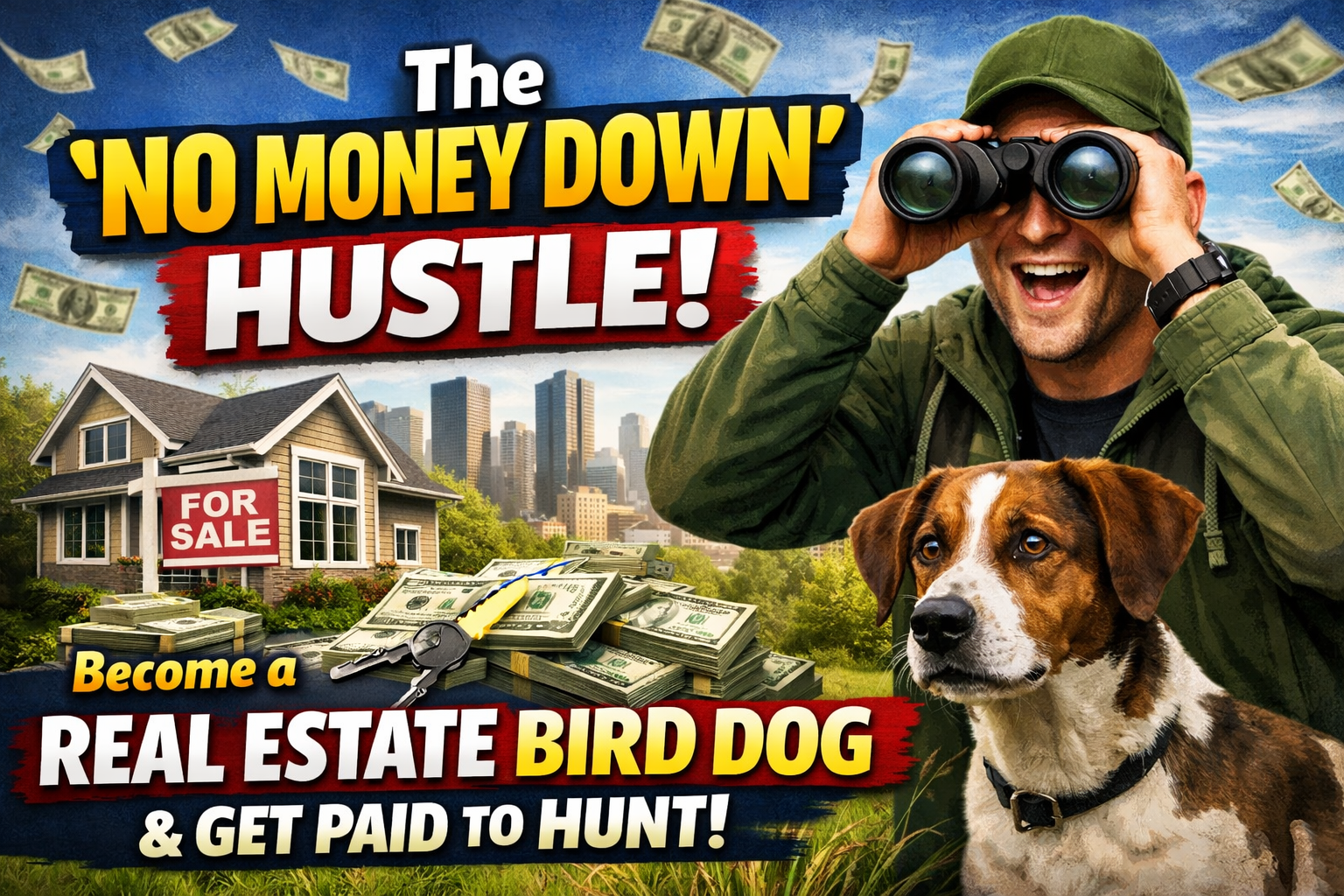
Broke but want to invest? Start as a real estate bird dog. Learn how to spot distressed properties, pass them to investors, and earn cash without buying a single house.
Table of Contents
I remember exactly where I was when I realized I couldn’t afford to be a real estate investor yet. I was 23, staring at a bank account with three digits in it, listening to a guru on a podcast talk about “putting 20% down.” That was laughable. I didn’t have 20% down for a pizza, let alone a duplex.
But I had time. And I had a car with a mostly working gas gauge.
That’s when I discovered the concept of being a real estate bird dog. It sounded weird—like I was joining a hunting club—but it turned out to be the single best entry point for anyone with more hustle than capital. I spent my weekends driving around neighborhoods, writing down addresses of ugly houses, and sending them to local flippers. A month later, I got a check for $1,000. I hadn’t bought anything. I hadn’t signed a mortgage. I had just pointed a finger.
If you are trying to break into the industry but your wallet is thin, this is your starting line. You don’t need credit. You don’t need a license (usually). You just need to know what a good deal looks like. Let’s break down how to become a successful real estate bird dog and start generating cash flow from thin air.
What Exactly is a Real Estate Bird Dog?
In the hunting world, a bird dog goes out into the tall grass, finds the pheasant, and flushes it out so the hunter can take the shot. In real estate, you are the dog. The investor is the hunter.
A real estate bird dog is a property scout. Your job is to find distressed properties—the ones with tall grass, boarded-up windows, or piles of newspapers on the porch—and pass that information to an experienced investor. If the investor buys the house, you get paid a “finder’s fee” or a referral fee.
It is the purest form of lead generation. Investors are busy. They are managing contractors, dealing with lenders, and selling houses. They don’t have time to drive up and down every street looking for “For Sale By Owner” signs. They will happily pay a real estate bird dog $500 to $2,000 for a qualified lead that turns into a profitable flip.
The Strategy: Driving for Dollars
This is the bread and butter of the real estate bird dog business. It’s called “Driving for Dollars.” You pick a neighborhood—preferably an older, working-class area where flips are common—and you drive. Slowly.
You aren’t looking for the pretty houses. You are looking for the ugly ones.
- Tall grass/weeds: The owner doesn’t care (or isn’t there).
- Blue tarps on the roof: Deferred maintenance.
- Code enforcement tape: The city is already involved.
- Full mailboxes: Nobody is home.
When you see these signs, you write down the address. Then, you do a little detective work. You go to the county tax assessor’s website (it’s free) and look up the owner. If the owner’s mailing address is different from the property address, bingo. It’s an absentee owner. These are the golden geese for a real estate bird dog.
Finding the Hunter (The Investor)
A pointer dog is useless without a hunter. You can find 100 distressed properties, but if you don’t have anyone to buy them, you are just a person with a list of addresses. You need to build a “Buyers List.”
Go to local REIA (Real Estate Investors Association) meetings. Look for “We Buy Houses” signs on telephone poles. Call them. Say this: “Hi, I’m a local real estate bird dog and I come across off-market distressed properties often. What specifically are you looking for, and do you pay referral fees?”
Most investors will say yes immediately. They are starving for inventory. Ask them for their “Buy Box”:
- What zip codes?
- What price range?
- Minimum profit margin?
Once you know what they want, you can stop hunting for squirrels and start hunting for the pheasants they actually want to shoot.
Link to BiggerPockets: How to Build a Buyers List
Getting Paid: The Fee Structure
This is the tricky part. How much is a lead worth? It depends on how much work you do.
Level 1: The Address Giver ($50 – $100) You just send an address and a photo. You don’t contact the owner. This is low value because the investor still has to skip-trace the owner, call them, and negotiate. Most investors won’t pay much for this unless you are a high-volume real estate bird dog.
Level 2: The Warm Lead ($500 – $1,000) You find the owner’s phone number. You call them. You confirm they want to sell. You hand the investor a seller who is ready to talk. This is worth real money.
Level 3: The Contract ($5,000+) At this point, you aren’t really a real estate bird dog anymore; you are a wholesaler. You negotiate the price, get it under contract, and assign that contract to the investor. This is where the big checks are, but it requires more skill and legal paperwork.
The Legal Warning (Don’t Skip This)
I have to put my serious face on for a second. In many states, brokering a real estate deal for a fee without a license is illegal. Technically, if you say, “I will sell this house for you for a commission,” you are acting as an unlicensed agent.
However, a real estate bird dog operates in a gray area.
- Option A: Sell the information, not the house. You are selling a list of leads.
- Option B: Get it under contract yourself (wholesaling). If you have an equitable interest in the property, you can sell that interest.
- Option C: Get your real estate license. It costs a few hundred bucks and solves the legal problem forever.
Always check your local state laws. You don’t want to get fined by the real estate commission for trying to make a few bucks as a real estate bird dog.
Link to National Association of Realtors: State Licensing Laws
Tools of the Trade
You don’t need much, but a few apps make the real estate bird dog life easier.
- DealMachine: This app lets you take a picture of a house, and it instantly pulls the owner’s data and sends them a postcard. It speeds up the process massively.
- OnX Hunt: Great for seeing property lines and owner data in rural areas.
- Excel/Google Sheets: You need a CRM to track your leads. If you lose the address, you lost the money.
From Bird Dog to Investor
The beauty of this hustle is the education. When you work as a real estate bird dog, you are getting paid to learn. You learn what a “distressed property” looks like. You learn how investors calculate repair costs (ARV). You learn how to talk to sellers.
Eventually, you will find a deal that is so good, you won’t want to pass it on. You will want to keep it. That is the graduation day. I bird-dogged for two years before I bought my first rental. By the time I signed my own deed, I wasn’t scared because I had watched twenty other deals close from the sidelines.
Why Investors Love You
Don’t feel like you are bothering people. A good real estate bird dog is an asset. Investors are lazy (or just efficient). They typically buy from the MLS, where competition is high. If you bring them an off-market deal that nobody else knows about, you are their best friend. I know investors who have bought their entire portfolio from one or two reliable scouts. If you are consistent, you become a partner, not just a gig worker.
Conclusion
The barrier to entry in real estate is usually money. But the barrier to entry for a real estate bird dog is just effort. It requires gas in the tank and the willingness to drive down streets that Google Maps forgot.
If you are reading this and thinking, “I can’t invest because I’m broke,” you are making an excuse. Go outside. Look for the peeling paint. Look for the overstuffed mailbox. Take a picture. Find a buyer. Get paid. It really is that simple to start. The only question is, are you willing to hunt?
Have you ever tried driving for dollars? Did you find a gem or just a lot of empty lots? Let me know your experience in the comments!
FAQ Section
1. Do I need a contract to be a real estate bird dog? It is highly recommended. You should have a simple “Fee Agreement” or “Non-Circumvention Agreement” with the investor. This ensures that if they buy the house you sent them, they legally owe you the fee. Without it, a shady investor could take your lead and ghost you.
2. How do I find the owner of a vacant house? Start with the County Tax Assessor’s website (search by address). If that fails, use skip-tracing websites like TruePeopleSearch or PropStream to find phone numbers. If all else fails, talk to the neighbors—they usually know the story.
3. Is bird dogging the same as wholesaling? Not exactly, though they overlap. A real estate bird dog typically just provides the lead (information) for a small fee ($500-$1,000). A wholesaler actually puts the house under contract and sells the rights to the contract for a much larger fee ($5,000-$20,000). Bird dogging is often the stepping stone to wholesaling.
4. Can I do this part-time? Absolutely. Most successful scouts start by doing this on weekends or on their commute home from work. You don’t need to quit your job to be a real estate bird dog. In fact, it’s the perfect side hustle to build your capital reserves.
5. What if the investor doesn’t buy the house? Then you don’t get paid. This is a performance-based gig. You only get paid if the deal closes. This is why it is critical to pre-screen your leads. Don’t send the investor junk; send them deals that actually make sense financially.
6. Is it better to focus on residential or commercial? For a beginner real estate bird dog, stick to residential (single-family homes). They are easier to identify, easier to value, and there are far more residential flippers looking for deals than there are commercial investors. Commercial is a different beast with longer timelines.