
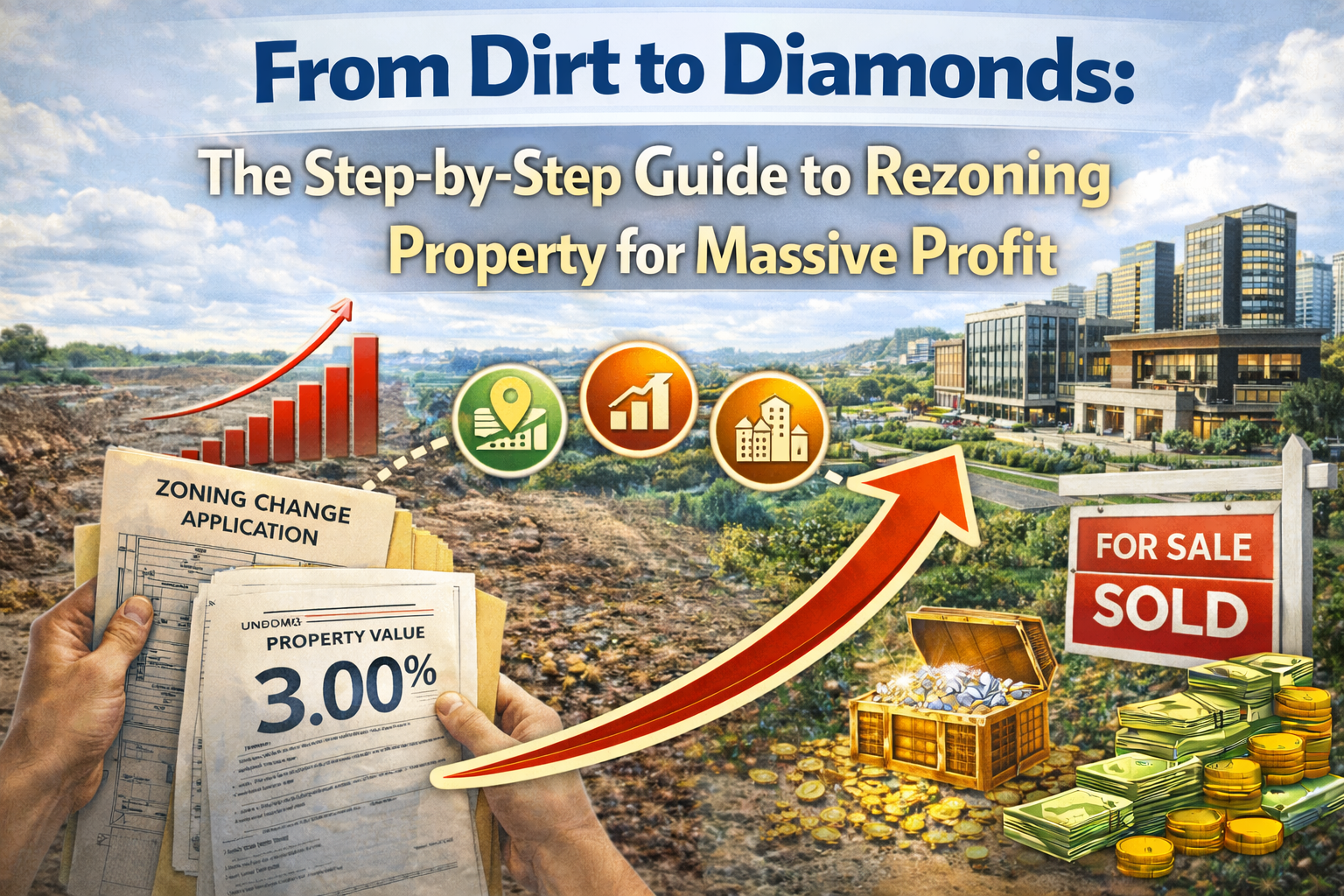
Sitting on land that isn’t living up to its potential? We break down the complex process of Rezoning Property to help you unlock hidden equity and skyrocket your land value.
Table of Contents
I once drove past a dilapidated single-family home on a busy corner every day for three years. It was an eyesore—overgrown grass, peeling paint, and a “For Sale” sign that looked like it had survived a hurricane. The asking price was $200,000, but nobody wanted it because who wants to live on a noisy intersection?
Then, a savvy investor named “Mike” bought it. He didn’t renovate the kitchen. He didn’t fix the roof. Instead, he spent six months dealing with paperwork at City Hall. He succeeded in Rezoning Property from “Residential” to “Neighborhood Commercial.”
Suddenly, that noisy corner wasn’t a bad place to live; it was a perfect place for a coffee shop. He sold the dirt (without driving a single nail) to a developer for $650,000.
That is the power of the pen. While most investors focus on improving the structures on the land, the real moguls focus on improving the rights to the land. Rezoning Property is the ultimate value-add play. It’s essentially alchemy—turning lead into gold by changing a designation on a map. But be warned: it is a bureaucratic maze filled with angry neighbors and grumpy city planners.
If you are ready to trade your hammer for a zoning application, let’s walk through exactly how to navigate the system and force appreciation on your next deal.
What Does Rezoning Actually Mean?
Every piece of land in your city has a label. These are land use regulations set by the local government to keep a slaughterhouse from being built next to a kindergarten.
- R-1: Single-family homes (low density).
- R-3: Apartments/Multi-family (high density).
- C-1: Commercial/Retail.
- I-1: Industrial.
Rezoning Property is simply the legal process of changing that label. Usually, the goal is “Upzoning”—moving from a less valuable use (like a single house) to a more valuable use (like a 20-unit apartment complex or a strip mall). By increasing the residential density or commercial potential, you instantly increase the land value because the future income potential of the site just multiplied.
Step 1: The Feasibility Study (Don’t Buy Yet)
Before you drop a dime on a purchase, you need to know if Rezoning Property is even possible. You can’t just turn a house in the middle of a quiet subdivision into a Walmart. The city won’t allow it. You need to look at the “Comprehensive Plan” (or Master Plan). This is a document that shows the city’s vision for the next 20 years.
If the Master Plan says your target area is destined for “Future Mixed-Use,” you have a green light. If it says “Protected Historic Residential,” walk away. You will never win that fight. During this phase, savvy investors often sign a purchase contract with a “Zoning Contingency.” This means: I will buy this land ONLY IF the city approves the Rezoning Property application. If they say no, you get your deposit back.
Step 2: The Pre-Application Meeting
Once you have the land under contract, you don’t just file the paperwork. You go on a date with the city planners. Most planning departments require a “Pre-App” meeting. You walk in with your sketch—maybe it’s a rough drawing of a 10-unit townhouse project.
The planner will look at it and tell you:
- “The setback requirements are too tight here.”
- “You need more parking spots.”
- “The neighbors are going to hate this.”
This feedback is gold. It tells you exactly what you need to change to get staff support. Remember, when you are Rezoning Property, the city planner is your gatekeeper. If they don’t like it, it likely won’t even make it to the City Council for a vote.
Step 3: The Neighborhood Meeting (The Lion’s Den)
This is the hardest part. In many jurisdictions, you are required to host a meeting for anyone living within 500 feet of the project. You have to stand in front of a room of homeowners and explain why you want to put an apartment building next to their backyard.
Expect resistance. The phrase “Not In My Backyard” (NIMBY) was invented for Rezoning Property meetings. They will complain about traffic. They will complain about noise. They will complain about property values dropping (even though new development usually raises them).
- Pro Tip: Don’t argue. Listen. If they are worried about privacy, offer to put up an 8-foot fence or plant mature trees. Making concessions here can save your project later.
Link to American Planning Association: Understanding Zoning
Step 4: The Planning Commission Hearing
If you survive the neighbors, you go to the Planning Commission. This is a board of appointed officials who advise the city council. They review your application to see if it fits the zoning ordinance.
They will hold a public hearing. The angry neighbors will show up again. Your job is to present the “Highest and Best Use” case. You need to show that Rezoning Property here benefits the community—maybe by providing needed housing or removing a blighted structure. If the Commission votes “Yes,” they recommend approval. If they vote “No,” you can still go to City Council, but you are swimming upstream.
Step 5: The City Council Vote
This is the final boss battle. The City Council (or County Board) are elected officials. They care about votes. If 50 angry voters show up screaming about your project, the Council might get cold feet.
However, if you have done your homework, engaged with the community, and have the support of the city planning staff, this is where the magic happens. They vote. If the gavel bangs in your favor, congratulations. Your Rezoning Property effort just paid off. That R-1 land is now R-3, and it’s likely worth double what you paid for it.
The Alternative: Variances and Conditional Use
Sometimes, you don’t need a full rezone. If you just want to build slightly closer to the street than allowed, you might need a Variance (an exception to the rule). If you want to run a daycare in a residential zone, you might need a Conditional Use Permit (CUP).
These are easier and cheaper than fully Rezoning Property, but they are temporary or specific. A rezone changes the law for that land forever; a CUP can sometimes be revoked if you break the rules.
The Cost of the Game
Don’t think this is cheap. Rezoning Property costs money.
- Application Fees: $1,000 – $5,000 depending on the city.
- Architects/Engineers: You need site plans and surveys. $5,000 – $20,000.
- Land Use Attorney: If the case is complex, you need a lawyer to argue for you. $250/hour adds up fast.
But remember Mike from the beginning of the story? He spent maybe $25,000 on fees to make $450,000 in profit. The ROI on Rezoning Property is infinite if you structure the deal right.
Link to Urban Land Institute: The Economics of Land Use
Spot Zoning: The Illegal Trap
A word of warning: You cannot just rezone one tiny lot in the middle of a neighborhood if it makes no sense. This is called Spot Zoning, and it is illegal in many states. Courts hate it because it looks like the city is playing favorites. Your request needs to be consistent with the surrounding area. You can usually rezone a corner lot (because corners are busier), but Rezoning Property in the middle of a cul-de-sac from residential to industrial? That will get sued and overturned instantly.
Conclusion
Real estate development is a game of vision. Most people see what is there. The wealthy see what could be there. Rezoning Property is the tool that bridges that gap.
It is frustrating, slow, and political. You will get yelled at by neighbors. You will get delayed by bureaucrats. But when you hold that piece of paper signed by the Mayor declaring your land is now zoned for a 4-story condo building, you realize it’s the most profitable paper in the real estate industry.
Don’t be afraid of the zoning map. It’s not set in stone; it’s just a suggestion waiting for a better idea.
Have you ever tried to change the zoning on a lot? Did the neighbors fight you? Tell me your war stories in the comments below!
FAQ Section
1. How long does the process of Rezoning Property take? It varies by city, but generally, you should expect 4 to 9 months. Smaller towns might move faster (3 months), while major metros like Los Angeles or New York can take years. Never bank on a quick flip when zoning is involved.
2. Can I rezone property myself, or do I need a lawyer? For simple requests (like a variance), you can often do it yourself. But for full Rezoning Property cases involving a change of use classification, hiring a Land Use Attorney or a specialized consultant is highly recommended. One paperwork error can restart the 6-month clock.
3. Does rezoning increase property taxes? Yes. Once the rezone is approved, the county assessor will likely re-evaluate the land based on its new “Highest and Best Use.” If you upzone from residential to commercial, expect your tax bill to jump significantly, even if you haven’t built anything yet.
4. What is “Downzoning”? This is the opposite of Rezoning Property for value. It’s when the city reduces the density allowed on your land (e.g., changing it from apartments to single-family). This usually hurts property value. Property owners often fight this tooth and nail.
5. Is a zoning change guaranteed? Never. Even if the city planners love your project, the City Council has the final vote. Politics plays a huge role. There is always a risk that you spend $20,000 on the process of Rezoning Property and get a “No” at the finish line.
6. Can neighbors stop a rezoning? They can’t legally “veto” it, but they have immense influence. A petition signed by 100 angry neighbors is terrifying to a City Council member running for re-election. Smart developers meet with neighbors early to make compromises before the public hearing.