
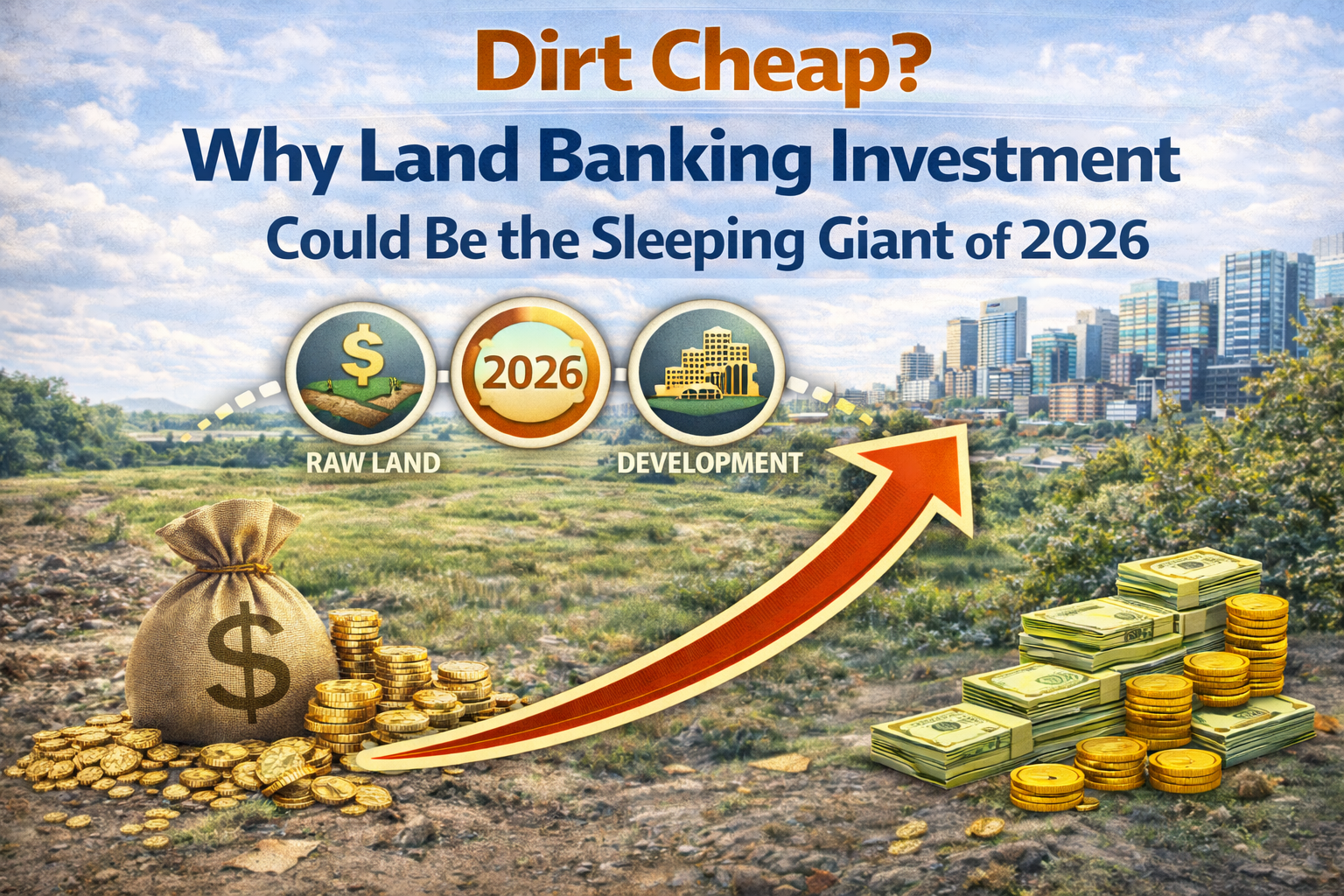
Tired of volatile markets? Land Banking Investment offers a hands-off way to build generational wealth. Discover why raw land might be the smartest buy this year.
Table of Contents
I used to work with an old developer named “harlan.” Harlan didn’t own fancy high-rises. He didn’t flip houses. He drove a beat-up Ford truck and wore muddy boots to every meeting. But Harlan was the richest guy in the room.
His secret? He bought dirt. Specifically, he bought dirt five miles past where the pavement ended. He would sit on it for ten or fifteen years, hunting on it, camping on it, doing absolutely nothing to it. Then, when the city eventually sprawled out to meet him, he’d sell that “useless” scrubland to a home builder for 20 times what he paid.
Harlan was a master of Land Banking Investment. It’s the oldest, simplest, and most boring strategy in real estate. And in 2026, with housing inventory at record lows and urban sprawl kicking into high gear again, it might just be the smartest move you can make.
While everyone else is fighting over overpriced duplexes and worrying about tenants trashing the carpet, land bankers are sleeping soundly. If you have patience and a little vision, let’s talk about why buying nothing but grass could be your ticket to retiring early.
What is Land Banking Investment?
Let’s strip away the fancy terminology. Land Banking Investment is the practice of buying raw, undeveloped land in the “path of progress” and holding it until it becomes valuable for development.
You aren’t trying to build a house. You aren’t trying to rezone it next week. You are banking the land. You are treating the soil like a savings account that compounds over time. The premise is simple: They aren’t making any more land. As the population grows, cities must expand. The farm on the edge of town today is the Walmart Supercenter of tomorrow. If you own that farm before Walmart calls, you win.
The “Path of Progress” Strategy
The trick isn’t just buying random land in the middle of nowhere. That’s not investing; that’s charity. Successful Land Banking Investment requires you to predict where the city is going. You look at the map.
- Where is the new highway exit being built?
- Where is the new sewer line being extended?
- Which direction are the big builders (like Lennar or DR Horton) moving?
I had a client buy 10 acres in Texas back in 2018. It was just cactus and dust. But he knew a new Tesla factory was planned 20 minutes away. He paid $50,000. Last year, he sold it to a multifamily developer for $1.2 million. He didn’t do anything to the land. The city came to him. That is the explosive potential of a well-timed Land Banking Investment.
Why 2026 is the Year for Dirt
Why now? Real estate is cyclical. We are currently in a cycle where developed properties (houses, apartments) are incredibly expensive due to construction costs. Labor is high. Materials are high. This squeezes profit margins for builders.
Builders are desperate for cheap land to make their numbers work. They are looking further out from the city center to find it. This drives demand specifically for the kind of raw parcels involved in Land Banking Investment. Additionally, with remote work now a permanent fixture for many, people are willing to live 45 minutes or an hour away from downtown. The “commuter zone” has expanded, making previously worthless rural land suddenly viable for subdivisions.
Link to Realtors Land Institute: The 2026 Land Market Survey
The Pros: The “Lazy” Investor’s Dream
If you hate fixing toilets, you will love this. Land Banking Investment is the ultimate passive income strategy (well, passive growth strategy).
- No Tenants: Dirt doesn’t call you at 2 AM to say the sink is leaking.
- No Termites: Bugs can’t eat dirt.
- Low Carrying Costs: Property taxes on raw land (especially if it has an agricultural exemption) are usually dirt cheap—sometimes less than $100 a year.
- High ROI Potential: It’s not uncommon to see returns of 500% or 1,000% over a decade.
The Cons: The “Negative Carry” Problem
I have to be honest with you—it’s not all sunshine. The biggest downside to Land Banking Investment is that it produces zero cash flow. A rental house pays you every month. Land costs you every month. You have to pay the taxes. You have to pay liability insurance. You might have to pay someone to mow it to keep the code enforcement officer happy.
This is called “negative carry.” You need to have the cash reserves to feed the investment for years without seeing a dime in return. You only get paid when you sell. If you need monthly income to pay your bills, Land Banking Investment is not for you.
Due Diligence: Don’t Buy a Swamp
I’ve seen people get burned because they bought land without checking what was underneath it. Before you write a check for a Land Banking Investment, you need to check:
- Topography: Is it flat? If it’s on a 45-degree slope, nobody can build on it.
- Flood Zone: Is it in a floodplain? If yes, it’s likely worthless for development.
- Utilities: How far away is the water line? If the nearest pipe is 5 miles away, it will cost millions to connect.
- Zoning: Can it eventually be rezoned? (See my previous post on this!).
One of my contacts bought a “great deal” on 5 acres only to find out it was 90% protected wetlands. He basically bought a very expensive frog habitat. He couldn’t build a doghouse on it, let alone a subdivision. His Land Banking Investment went to zero.
Financing: Cash is King
Banks hate lending on raw land. Why? Because if you stop paying, they can’t rent it out. It’s a risky asset for them. Typically, you need 50% down to get a land loan, and the interest rates are higher than mortgage rates.
Most people pursuing Land Banking Investment use cash or seller financing. In fact, seller financing is huge in the land world. Many old farmers are happy to act as the bank. You pay them a monthly payment for 5 or 10 years. This allows you to control a large piece of property with a small down payment, keeping your liquidity free for other deals.
Link to Land.com: Investing in Land 101
Who Should Buy Land?
This strategy is for the patient wealth builder. If you are 30 years old and want to have a massive nest egg when you are 50, Land Banking Investment is perfect. If you are a high-income earner (doctor, lawyer, tech sales) looking to park cash where the IRS can’t easily tax it (via 1031 exchanges), land is a great shelter.
It is NOT for flippers. Buying land expecting to sell it next year for a profit is gambling, not investing. The appreciation curve takes time.
Conclusion
Harlan, that old developer I mentioned? He died a few years ago. He left his kids a portfolio of “useless” dirt that is now being turned into a master-planned community worth $40 million. He played the long game.
Land Banking Investment is the contrarian play. It’s unsexy. It’s quiet. It doesn’t make for good reality TV. But while other investors are stressing over interest rate hikes and eviction moratoriums, the land banker is just watching the grass grow and waiting for the city to come to them.
If you have the patience and the capital, go look at the edge of town. Drive until you see the last subdivision. Then drive five more minutes. That’s where the gold is.
Do you own any raw land? Are you holding it for development or just for a weekend getaway? Let me know in the comments!
FAQ Section
1. Is land a liquid asset? No. Land is notoriously illiquid. Unlike a stock you can sell in seconds, or a house you can sell in a month, a Land Banking Investment can take 6 to 12 months (or longer) to sell. Do not put your emergency fund into land.
2. How do I make money if I don’t sell? You can sometimes generate small income while you wait. You can lease the land to a farmer for crops or grazing (this also keeps your taxes low via “Ag Exemption”). You can lease it to hunters. You can even lease it for solar farms or cell towers if the location is right.
3. What is an “Ag Exemption”? This is a tax break given to properties used for agriculture (farming, ranching, timber). It dramatically lowers your property tax bill. Smart investors practicing Land Banking Investment often buy land that already has this exemption and pay a local farmer to cut hay on it just to keep the taxes low.
4. Can I build a tiny house on my land while I wait? Maybe. Check the local zoning. Some counties allow it; others require a minimum square footage for a primary dwelling. If you just want a weekend cabin, it’s usually easier, but you still need a septic permit and water source.
5. Is land a good hedge against inflation? Yes. Land is a “hard asset.” Historically, when the dollar loses value (inflation), hard assets like gold and real estate increase in price. Because they aren’t making any more land, it creates natural scarcity that protects your purchasing power over decades.
6. Do I need a realtor to buy land? I recommend it, but make sure they are a “Land Specialist.” A residential agent who sells condos usually doesn’t understand soil tests, mineral rights, or easements. You need an expert who speaks the language of Land Banking Investment to avoid costly mistakes.