
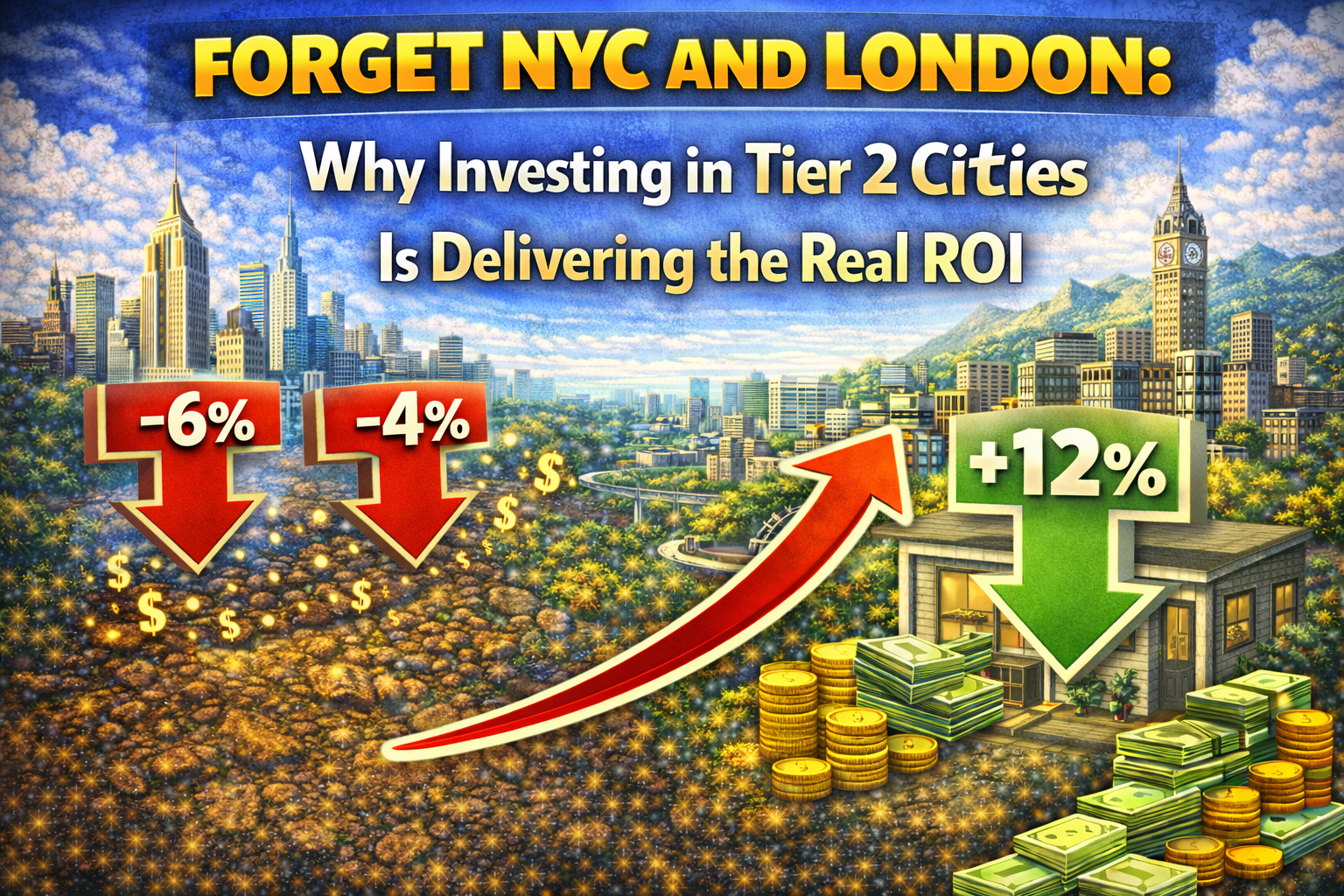
Tired of overpriced metros with shrinking yields? Discover why smart money is shifting to Investing in Tier 2 Cities, where capital appreciation and rental yields are hitting record highs.
Table of Contents
I was sitting at a dinner party recently with a buddy of mine, “Dave,” who has been obsessed with buying a rental property in a major metro downtown for years. He finally found a “deal”—a 500-square-foot condo that cost him nearly $700,000. He was bragging about the prestige, the location, the skyline view.
Then I asked him about the numbers. “What’s your cap rate?” I asked. He did some mental gymnastics and mumbled, “Well, after the HOA fees and taxes… maybe 2%?”
Dave bought an expensive trophy. He didn’t buy an investment. Meanwhile, savvy investors are quietly making a fortune by looking where everyone else isn’t: the “second-tier” markets. Investing in Tier 2 Cities has moved from a niche strategy to the dominant play for high-growth portfolios in 2026.
While the big metros are saturated, expensive, and yielding pennies, these emerging hubs are offering the kind of growth we haven’t seen since the early 2000s. If you want to build real wealth rather than just owning a prestigious zip code, you need to understand why the tide is turning. Let’s break down why smaller cities are delivering bigger checks.
The Metro Squeeze: Why the Big Dogs Are Barking Up the Wrong Tree
We need to be honest about the state of Tier 1 cities. Whether it’s New York, London, or San Francisco, the story is the same: prices are astronomical, and rents have hit a ceiling. When you are Investing in Tier 2 Cities, you are avoiding the “Metro Squeeze.”
In a major metro, you are competing with hedge funds, foreign oligarchs, and massive REITs. They bid prices up to the point where cash flow is almost impossible. You are banking entirely on appreciation—hoping the market keeps going up forever. That is a dangerous game.
In contrast, Investing in Tier 2 Cities allows you to enter the market at a price point that actually makes sense. You can buy a single-family home for $300,000 that rents for $2,500. The math works on day one. You aren’t subsidizing the tenant’s lifestyle with your negative cash flow; you are putting money in your pocket.
The Remote Work Revolution is Permanent
Critics said everyone would rush back to the office by 2023. They were wrong. Hybrid work is the new normal. This single shift has been the rocket fuel for Investing in Tier 2 Cities.
Professionals realized they didn’t need to pay $4,000 a month for a closet in the city center to be close to a job they only visit twice a week. They moved to cities like Austin, Charlotte, Manchester, or Boise—places that offer a higher quality of life, better schools, and bigger backyards.
This migration created a massive supply-and-demand imbalance in these markets. When you start Investing in Tier 2 Cities, you are capitalizing on this demographic shift. You are providing housing for the high-income tech worker who just left Silicon Valley to raise their kids in a place where they can actually afford a lawn.
Infrastructure: The “Path of Progress”
Real estate follows the pavement. Tier 1 cities are built out. There is nowhere left to put a new highway or a new train line without spending billions and waiting decades. Tier 2 cities, however, are in a construction boom.
When I look for deals, I look for cranes. Investing in Tier 2 Cities is lucrative because you can catch the “infrastructure wave.”
- New Airports: Cities expanding their terminals to international status.
- Metro Lines: New light rail systems connecting suburbs to downtowns.
- Tech Parks: Massive corporate campuses being built where land is cheap.
If you buy property before the new Amazon warehouse or the new light rail station opens, your property value skyrockets overnight. This creates capital appreciation that stagnant metros simply cannot match.
The Rental Yield Advantage
Let’s talk about the holy grail: Rental Yield. In top-tier metros, a gross rental yield of 3% is considered “good.” When Investing in Tier 2 Cities, seeing yields of 5%, 6%, or even 8% is common.
Why? The price-to-rent ratio is healthier. Property prices in these emerging markets haven’t outpaced local wages to the same insane degree as in the metros. I recently helped a client sell a $800k condo in a metro that rented for $3,500/month. We moved that equity into Investing in Tier 2 Cities, buying three separate houses for $250k each. Total rent? $6,000/month. He almost doubled his income just by changing his zip code strategy.
Lower Entry Barriers for Beginners
If you are just starting out, the barrier to entry in a major city is a brick wall. You need a massive down payment. Investing in Tier 2 Cities democratizes real estate. You don’t need half a million dollars cash. You might need $40k or $50k for a down payment.
This allows for diversification. Instead of having all your eggs in one expensive basket, you can own three properties across different neighborhoods. This spreads your risk. If one tenant moves out, you still have two others paying the mortgage. You can’t do that with a single studio apartment in the city.
The “Smart City” Effect
Many Tier 2 governments are hungry. They want to attract business. They are offering tax incentives, cutting red tape, and upgrading digital infrastructure to become “Smart Cities.” They are nimble. While big cities are bogged down in bureaucracy, smaller cities are approving permits faster. For a developer or an investor doing a “fix and flip,” speed is money. Investing in Tier 2 Cities often means dealing with a planning department that actually wants you to build, rather than one that actively tries to stop you.
Link to Forbes: The Rise of Secondary Cities
Risks to Watch Out For
I’m bullish, but I’m not blind. Investing in Tier 2 Cities comes with specific risks you need to manage.
- Liquidity: In a recession, big cities stay liquid. You can always sell a London flat. In a smaller city, the market can freeze up if the local economy takes a hit.
- Economic Diversity: Some Tier 2 cities rely on one or two major industries (like a factory town). If that factory closes, your tenant pool evaporates.
- Property Management: Finding reliable property managers in smaller towns can sometimes be harder than in established metros with big firms.
Successful Investing in Tier 2 Cities requires due diligence. You need to ensure the city has a diverse economy—universities, hospitals, and tech—not just one big employer.
Conclusion
The era of “Metro or Bust” is over. The data is clear. The population is moving. The jobs are moving. And the smart capital is moving with them.
Investing in Tier 2 Cities offers a rare combination of cash flow and growth potential that is becoming extinct in the primary markets. It allows you to buy better assets, get higher yields, and ride the wave of urbanization spreading across the country.
Don’t be like Dave. Don’t buy the trophy for the ego. Buy the cash flow for the bank account. Look at the map, find the city that is growing faster than it can build, and plant your flag there.
Are you currently looking outside your local market? Drop a comment below with the cities you are watching—I’d love to compare notes on the next hot spot!
FAQ Section
1. What exactly counts as a Tier 2 city? There is no strict scientific definition, but generally, these are cities with a population between 500,000 and 1 million (though this varies by country). They are regional hubs with their own airports and economies, but they lack the massive global influence of a Tier 1 city like New York or Tokyo. Think Austin, Nashville, or Manchester.
2. Is it safe to invest in a city I don’t live in? Yes, but you need a team. Investing in Tier 2 Cities remotely works if you have a “boots on the ground” partner—a trusted local realtor and a property management company. Do not try to self-manage a property that is a three-hour flight away.
3. Will prices in Tier 2 cities crash? Real estate is cyclical. However, many experts believe Tier 2 markets are less volatile than the luxury metro markets because they are driven by fundamental demand (people needing homes) rather than speculative luxury investment.
4. How do I choose the right Tier 2 city? Look for the “Big Three”: Population Growth, Job Growth, and Infrastructure Spending. If people are moving there, jobs are being created, and the government is building roads, it is a prime target for Investing in Tier 2 Cities.
5. Are interest rates different for Tier 2 properties? Generally, no. Mortgage rates are determined by your creditworthiness and the asset type (investment vs. primary residence), not the city tier. However, some local credit unions in Tier 2 cities might offer aggressive rates to encourage local investment.
6. Is appreciation slower in Tier 2 cities? Historically, yes. But in the last 5 years, this has flipped. Many Tier 2 markets have seen higher percentage appreciation than Tier 1 markets because they started from a lower base price. A $200k house going to $300k is a 50% jump, which is harder to achieve on a $2M asset.