
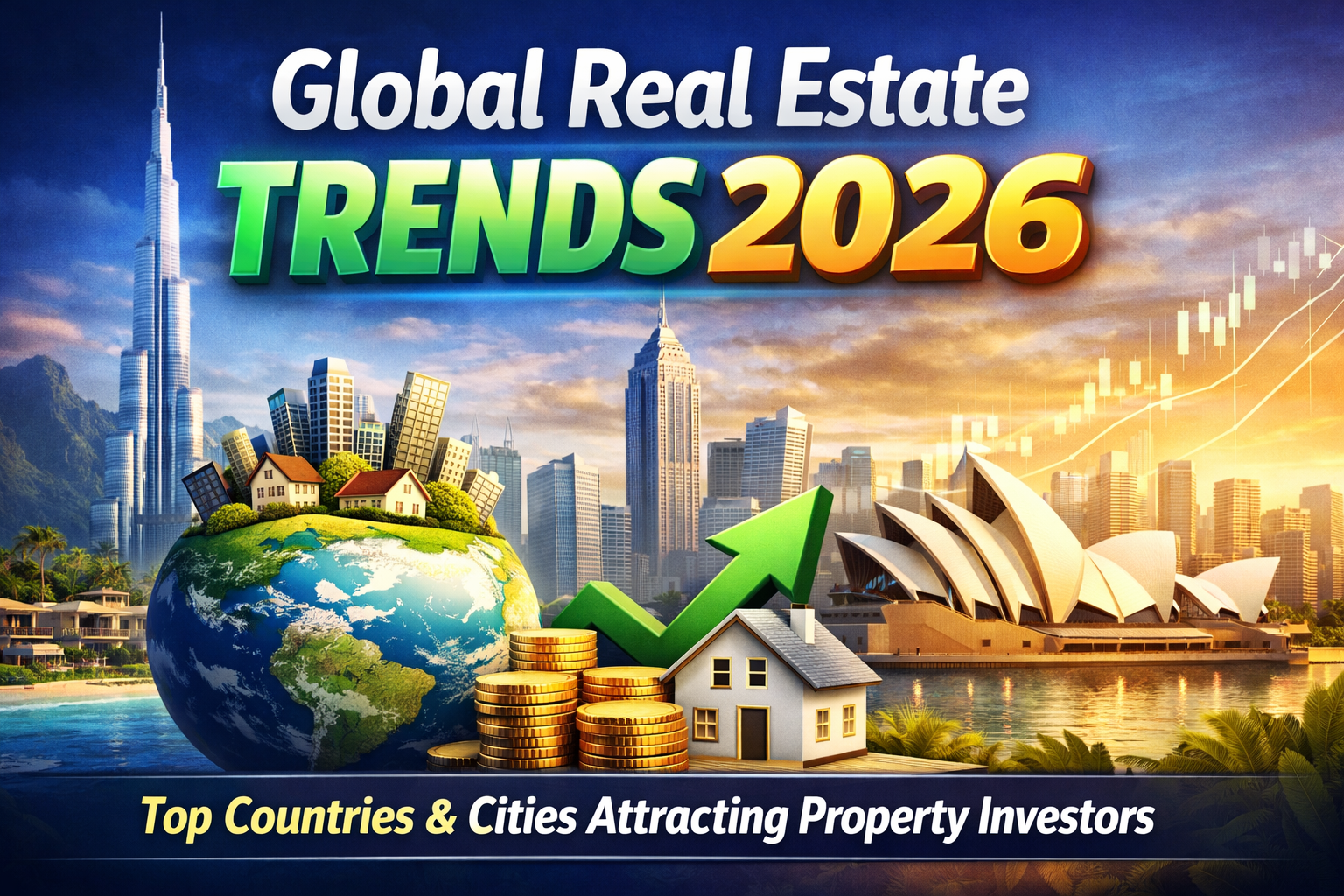
Global Real Estate Trends 2026 : Discover the top global real estate trends in 2026 and explore where investors are buying property worldwide. Learn about emerging markets, high-ROI cities, and future investment hotspots.
Table of Contents
Introduction
The global real estate market in 2026 is undergoing a major transformation. Changing economic policies, digital innovation, migration patterns, and evolving lifestyle preferences are reshaping where and how investors allocate capital. Unlike the past decade—dominated by a few traditional markets—today’s investors are diversifying across continents to capture higher yields, stable returns, and long-term appreciation.
From booming Middle Eastern cities to rapidly urbanizing Southeast Asia, real estate is no longer just about location—it’s about global strategy.
This article explores the key real estate trends of 2026 and highlights where smart investors are buying property right now.
1. Shift Toward High-Growth Emerging Markets
One of the biggest trends in 2026 is the movement of investment away from saturated Western markets toward emerging economies.
Why Investors Are Moving:
- Lower property acquisition costs
- Faster urbanization and infrastructure development
- Rising middle-class demand for housing
- Higher rental yields compared to developed nations
Key Destinations:
- Vietnam – Rapid manufacturing growth and expat demand
- India – Expanding metro cities and digital economy boom
- Indonesia – Tourism recovery and residential expansion
- Mexico – Nearshoring trend boosting housing demand
Investors are targeting these regions for long-term appreciation rather than short-term flipping.
2. The Middle East Is Becoming a Global Investment Magnet
Cities like Dubai, Abu Dhabi, and Riyadh are redefining luxury and tax-efficient investing. Government-led economic diversification programs are attracting global wealth and institutional investors.
Key Drivers:
- Zero or low property tax environments
- Investor-friendly residency programs
- Mega infrastructure and smart-city projects
- Strong demand for luxury and branded residences
The Middle East is now seen as a safe haven market combining stability with aggressive growth potential.
3. Rental Yield Is Now More Important Than Capital Appreciation
With global interest rates stabilizing but still elevated compared to pre-2020 levels, investors are prioritizing cash flow over speculation.
What’s Changing:
- Focus on rental income instead of quick resale
- Demand for multi-family housing and serviced apartments
- Growth in student housing and co-living developments
Markets delivering 6%–10% rental yields are outperforming traditional cities where yields remain below 4%.
4. Secondary Cities Are Outperforming Mega Cities
Investors are increasingly avoiding ultra-expensive gateway cities like London, New York, and Hong Kong in favor of fast-growing secondary cities.
Why Secondary Cities Are Winning:
- Lower entry costs
- Higher population growth rates
- Infrastructure expansion (metros, airports, tech hubs)
- Better affordability attracting young professionals
Examples:
- Austin & Nashville (USA)
- Valencia (Spain)
- Pune & Ahmedabad (India)
- Da Nang (Vietnam)
These cities are delivering balanced growth + livability, making them magnets for both residents and investors.
5. Technology Is Transforming Property Investment
PropTech is now a major driver of global real estate decisions.
Innovations Shaping 2026:
- AI-powered property valuation tools
- Virtual property tours for cross-border buyers
- Blockchain-based transactions increasing transparency
- Smart-home demand increasing resale value
- Fractional ownership platforms allowing smaller investors to enter global markets
Technology is enabling investors to buy property across continents without physical presence, accelerating globalization of the sector.
6. Sustainable and Green Buildings Are No Longer Optional
Environmental regulations and tenant preferences are pushing developers toward sustainable construction.
Investors Are Prioritizing:
- Energy-efficient buildings
- Net-zero developments
- Smart water and waste systems
- ESG-compliant commercial spaces
Green-certified properties are seeing:
- Higher occupancy rates
- Lower operational costs
- Stronger long-term valuation
In 2026, sustainability is not just ethical—it’s financially strategic.
7. The Rise of Lifestyle-Driven Real Estate
Post-pandemic living patterns continue influencing property demand worldwide. Buyers are prioritizing quality of life over proximity to financial districts.
High-Demand Property Types:
- Coastal residences
- Wellness-focused communities
- Remote-work-friendly homes
- Mixed-use developments combining living, retail, and workspace
Countries offering digital nomad visas are benefiting from this shift, attracting mobile professionals who rent long-term.
8. Supply Shortages Are Supporting Long-Term Price Growth
Despite economic uncertainty, many global markets face a structural housing shortage.
Causes:
- Slower construction due to rising material costs
- Urban population growth
- Land scarcity in major cities
- Government zoning restrictions
This imbalance between supply and demand is expected to support steady price appreciation through 2030.
9. Cross-Border Investment Is Becoming Mainstream
International diversification is now a key strategy for both institutional and individual investors.
Reasons Investors Are Going Global:
- Currency diversification
- Access to faster-growing economies
- Reduced dependence on one national market
- Portfolio risk balancing
Real estate is increasingly treated like a global asset class—similar to equities or commodities.
10. Governments Are Competing to Attract Property Investors
Many nations are introducing policies designed to attract foreign buyers and stimulate economic growth.
Popular Incentives in 2026:
- Residency-by-investment programs
- Reduced transaction taxes
- Simplified property ownership laws
- Infrastructure-led development zones
Countries understand that real estate investment fuels employment, tourism, and urban expansion.
Top Global Investment Hotspots in 2026
| Region | Why Investors Are Buying |
|---|---|
| Middle East | Tax advantages + luxury demand |
| Southeast Asia | High economic growth |
| India | Urban expansion + tech sector |
| Southern Europe | Lifestyle migration + tourism |
| Latin America | Affordable entry + rental demand |
What This Means for Investors
The 2026 real estate landscape rewards investors who:
✔ Think globally rather than locally
✔ Focus on rental yield and usability
✔ Target emerging growth corridors
✔ Leverage technology for cross-border deals
✔ Prioritize sustainable developments
✔ Invest in livability-driven markets
The era of buying property purely for speculation is fading. The future belongs to data-driven, globally diversified investors.
Conclusion
Global real estate in 2026 is defined by opportunity, but only for those willing to adapt to shifting dynamics. Emerging markets, technology integration, sustainability, and lifestyle changes are rewriting the rules of property investment.
Investors who recognize these macro trends early are positioning themselves for the next decade of growth—while those clinging to traditional markets may see slower returns.
Real estate is no longer just about “location, location, location.”
In 2026, it’s about strategy, diversification, and future readiness.