
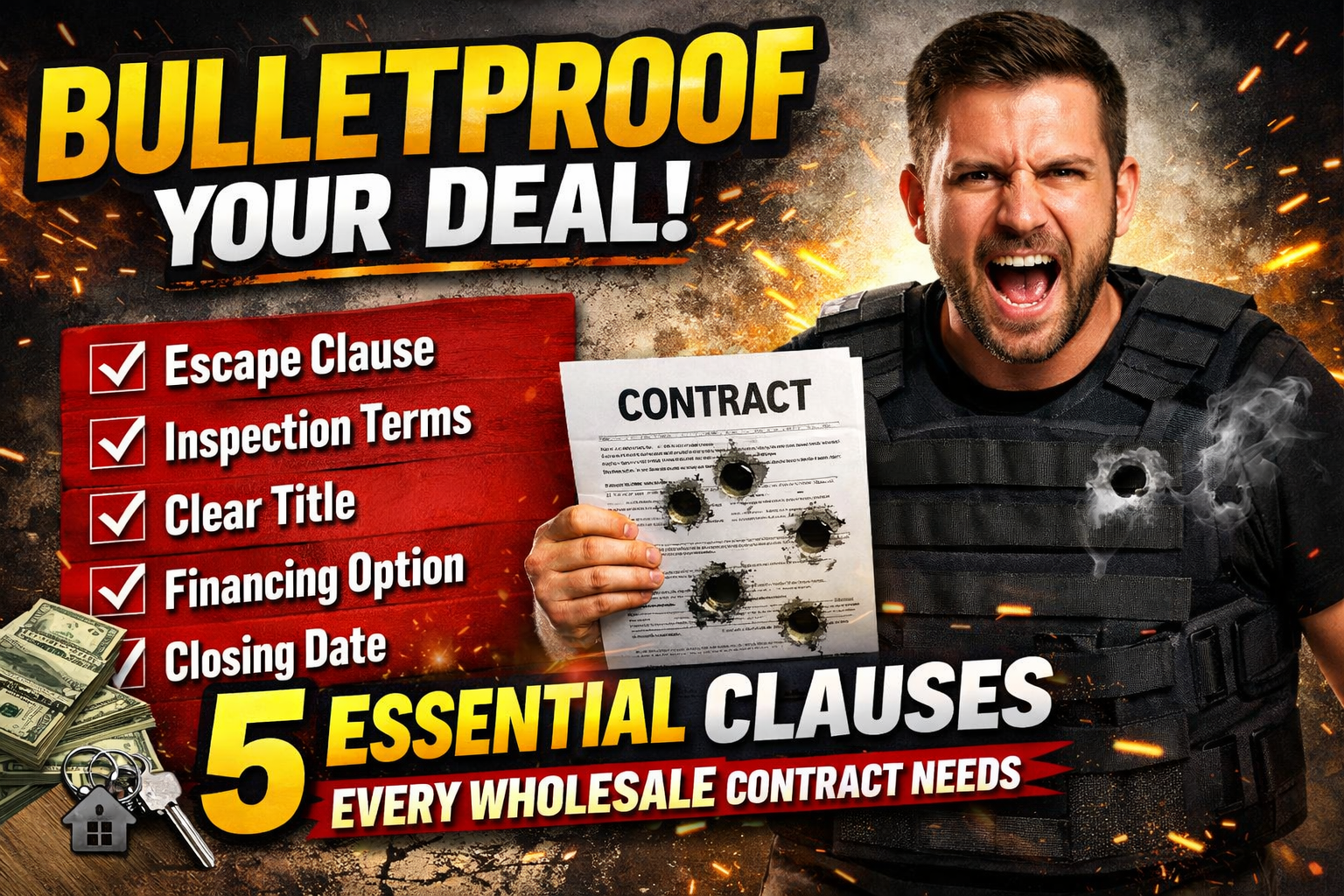
wholesale real estate contracts : Don’t lose your assignment fee to a bad document. We break down the non-negotiable clauses in wholesale real estate contracts that protect your profit and your sanity.
Table of Contents
I still remember the first time I lost a $10,000 assignment fee. It hurts to even type that number.
I had a distressed property under contract—a beat-up bungalow in a rapidly gentrifying neighborhood. The seller was motivated, the numbers worked, and I had a cash buyer lined up who was practically drooling over the deal. I felt like a genius.
Then, my buyer asked for a walkthrough. I called the seller to arrange it. “No,” the seller said. “You saw it already. No more visitors.” I checked my paperwork. I had downloaded a generic “Purchase and Sale Agreement” from a free legal website. It said nothing about access for partners or contractors. My buyer walked. The contract expired. I made zero dollars.
That was the day I learned that wholesale real estate contracts are not just formalities; they are the lifeboats that keep your deal afloat when things get choppy. If you are using a standard Realtor contract or a napkin scribble, you are exposing yourself to massive risk.
Wholesaling is a game of speed and control. To win, you need paperwork that gives you flexibility. Whether you are flipping contracts in Texas or double-closing in Florida, here are the essential clauses you absolutely need to include to ensure you actually get paid.
The “And/Or Assigns” Clause: The Holy Grail
If you take nothing else from this post, remember this. In standard real estate, the person who signs the contract is the person who buys the house. In wholesale real estate contracts, that is rarely the case. You (the wholesaler) are signing the contract with the intent to sell the contract itself to an end buyer.
To make this legal, you must add the words “and/or assigns” after your name on the Buyer line.
- Example: “Buyer: John Doe and/or assigns.”
This tiny phrase tells the seller (and the title company) that you have the right to transfer your interest in the property to another entity. Without it, you are legally obligated to close on the house yourself. If you don’t have the cash to buy it, you will be in breach of contract.
Most standard state-approved contracts forbid assignment by default. You have to override that. Pro Tip: If a seller asks why that language is there, be honest but brief. Tell them, “I work with partners and private lenders, and we often close in the name of an LLC or a trust. This just gives us the flexibility to put the correct name on the title at closing.”
The Inspection Clause (Your Escape Hatch)
Sellers get cold feet. Foundations crack. Termites happen. You need a way out. In wholesale real estate contracts, the inspection clause is your safety net. It allows you a specific period (usually 10 to 15 days) to inspect the property and, crucialy, to cancel the agreement if you don’t like what you find.
Real talk: This is also your marketing period. While you are “inspecting” the property, you are also sending pictures to your cash buyers list. If nobody wants to buy the deal, you know you priced it too high. If you can’t find a buyer during the inspection period, this clause allows you to back out and get your Earnest Money Deposit (EMD) back.
Warning: Don’t abuse this. If you constantly lock up properties and cancel at the last minute because you couldn’t find a buyer, you will get a bad reputation in town. Use the inspection period to verify the numbers, not just to string sellers along.
The Access Clause: Let Them In
Remember my $10,000 mistake? This is how you fix it. Your end buyer (the flipper or landlord) is not going to wire $200,000 without seeing the inside of the house. Most standard wholesale real estate contracts don’t explicitly grant access after the initial showing.
You need a clause that specifically states: “Buyer and Buyer’s partners, contractors, and inspectors shall have access to the property during the inspection period with 24-hour notice.”
Notice the word “partners.” In wholesaling, your “partner” is your cash buyer. This language allows you to bring them through the house legally. If the seller tries to block you, you can point to this paragraph. It turns a “favor” into a “contractual right.”
Link to Investopedia: What is a Purchase and Sale Agreement?
The Earnest Money Deposit (EMD) Terms
How much skin do you have in the game? In a traditional retail sale, a buyer might put down 1% to 3% of the purchase price. On a $300,000 house, that’s up to $9,000. As a wholesaler, you want to keep this low. Why? Because deals fall apart.
I typically aim for $100 to $500 as an EMD on wholesale real estate contracts. Why so low? Because if I mess up and breach the contract (outside of my inspection period), the EMD is usually the maximum damages the seller can claim. I’d rather lose $100 than $5,000.
Your contract needs to state clearly:
- Amount: “$100.00”
- Holder: “Held in escrow by Buyer’s Title Company.”
- Never give the money directly to the seller. If the deal falls through, good luck getting cash back from a distressed seller who just spent it on bills. Always use a neutral third party.
Closing Date and Extensions
Distressed real estate is messy. Title issues pop up. Heirs come out of the woodwork. Probate takes longer than expected. A rigid closing date can kill a deal. In your wholesale real estate contracts, try to include language that allows for an automatic extension if title issues arise.
“Closing shall occur on or before [Date]. If clear title cannot be provided by said date, Buyer reserves the right to extend closing for an additional 30 days.”
This saves you from having to chase the seller down to sign an addendum every time the title company finds an old lien. It keeps the deal alive automatically.
“As-Is” Language (Protecting the Seller)
This might sound counterintuitive, but you need to protect the seller to protect yourself. Wholesale properties are usually fixer-uppers. Your contract should explicitly state that the property is being sold “As-Is, Where-Is, with all faults.”
Why do you want this? Because you are about to assign this contract to a flipper. If the flipper buys it and finds mold behind the drywall, you don’t want them suing the seller (or you) for non-disclosure. By making it clear in the wholesale real estate contracts that this is an ugly house sale, you set the expectation that no repairs will be made and no warranties are given. It keeps the transaction clean.
Link to BiggerPockets: The Ultimate Guide to Wholesaling Real Estate
The Assignment Contract (The Second Piece of Paper)
So far, we’ve talked about the A-to-B contract (Seller to You). But remember, there is a second document involved: the Assignment Agreement (You to Buyer). This isn’t the purchase contract; it’s the document that sells the rights to that contract.
This document needs to be crystal clear about your fee. “Assignee (Cash Buyer) agrees to pay Assignor (You) an assignment fee of $15,000 at closing.” It should also state that the assignment fee is non-refundable once they sign. Once your buyer signs this and puts up their non-refundable deposit (usually much higher, like $2,000 – $5,000), you are safe. If they walk away, you keep their deposit.
Conclusion
I know, paperwork is boring. You got into real estate to do deals, not to play lawyer. But in the world of wholesale real estate contracts, the paper is the product. You aren’t selling houses; you are selling paper. If your paper is weak, your product is worthless.
Don’t rely on the “standard” forms your local Realtor board uses. Those are designed to protect homeowners living in the house, not investors buying distressed assets. Take the time to build a contract suite that includes these clauses. Consult with a local real estate attorney to ensure they comply with your specific state laws (especially in states like Illinois or Oklahoma where wholesaling regulations are tightening).
Once you have a solid contract template, you can move with speed and confidence. And trust me, looking at a signed contract with a locked-in $15,000 spread feels a lot better than looking at a cancelled deal because you forgot the access clause.
Have you ever had a deal fall apart because of the contract? Tell me your horror story in the comments—I promise I won’t laugh (too hard).
FAQ Section
1. Is wholesaling real estate legal? Yes, but with caveats. Wholesaling is the business of selling contracts, not properties. As long as you are selling your equitable interest in the contract (and not acting as an unlicensed broker representing the seller), it is legal in most states. However, states like Illinois, Philadelphia, and Oklahoma have passed laws requiring licenses for wholesaling. Always check your local laws.
2. Can I use a standard Realtor contract for wholesaling? You can, but it’s difficult. Most Realtor contracts (like the FAR/BAR in Florida) are designed for retail buyers. They often prohibit assignment without seller consent. If you must use one, you need to add an addendum that specifically allows for assignment.
3. Who pays the closing costs in a wholesale deal? Typically, the end buyer (cash buyer) pays all closing costs. Your wholesale real estate contracts should specify that the buyer pays “all closing costs, transfer taxes, and title fees.” Your assignment fee should be a “net” number to you.
4. What if I can’t find a buyer? This is why the Inspection Clause is critical. If you are within your inspection period, you can cancel the contract and walk away. If you are outside that period, you will likely lose your Earnest Money Deposit. This is the risk of the business.
5. Do I need a license to sign wholesale real estate contracts? Generally, no. You are acting as a principal buyer. You are signing a contract to buy a home. You do not need a license to buy a home for yourself (or your entity). The line gets blurry if you start marketing the house publicly before you own it, which is why marketing the contract to private buyers is the safer route.
6. Can I wholesale a property with a mortgage? Yes, but the mortgage must be paid off at closing. Your cash buyer’s funds will go to the title company, the title company will pay off the seller’s old mortgage, pay your assignment fee, and give the remaining cash to the seller. This is a standard closing process.