
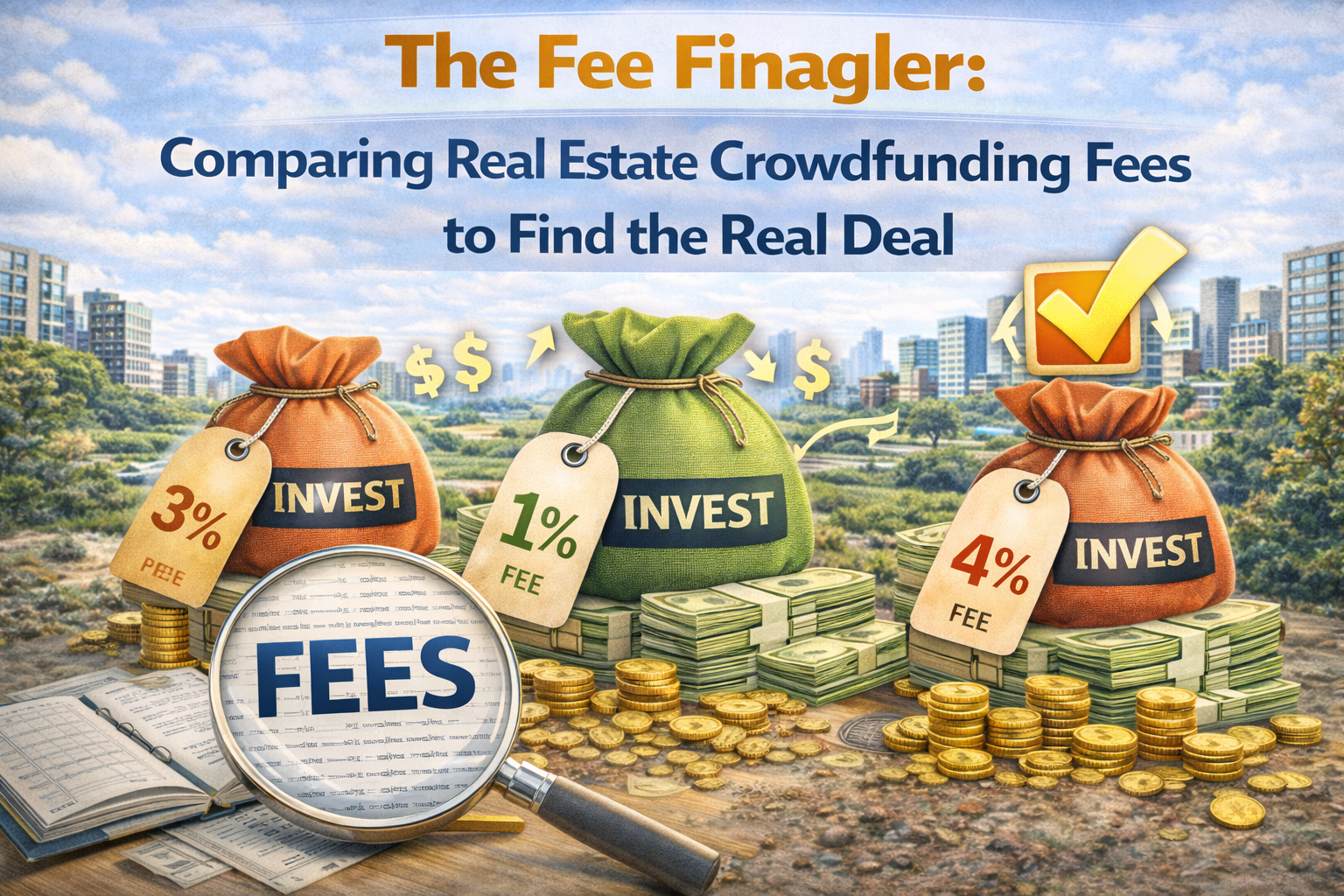
Stop losing your profits to fine print. We break down the confusing world of Real Estate Crowdfunding Fees, comparing top platforms to see who actually charges the least.
Table of Contents
I remember my first foray into online investing. I felt like a genius. I threw $5,000 into a popular platform, expecting to sit back and watch the passive income roll in like mailbox money. I pictured myself sipping a margarita while my “eREIT” did the heavy lifting.
Then I read the annual report.
Between the “asset management fee,” the “advisory fee,” and something vaguely called an “acquisition fee,” my projected 8% return looked a lot more like 5.5%. I felt duped. I realized then that Real Estate Crowdfunding Fees are the silent killers of compounding interest.
If you are looking to diversify your portfolio without buying a physical landlord headache, crowdfunding is fantastic. But the platforms aren’t charities. They are businesses, and they have very creative ways of getting paid. If you aren’t careful, those fees can eat up a third of your profits before you even see a dime.
Let’s strip away the marketing fluff and look at the actual cost of doing business. We are going to compare the fee structures of the big players and figure out who is charging what, and more importantly, who is worth it.
The Three Layers of Fees (The Stuff They Hide)
Before we name names, you need to understand the anatomy of the bill. Most beginners look at the “Platform Fee” and stop there. That is a rookie mistake. Real Estate Crowdfunding Fees usually come in three distinct layers:
- Platform/Advisory Fee: This is the cover charge. It’s what you pay just to use the website and have them manage your account. Usually 0.15% to 1% annually.
- Asset Management Fee: This pays for the people actually running the properties—fixing toilets, negotiating leases, paying taxes. This is often buried in the fine print of the individual offering circular. It can range from 1% to 2%.
- The “Promote” (Performance Fee): This is the big one. The sponsor (the developer) often takes a cut of the profits after you get your money back. It’s essentially a bonus for doing a good job.
When you add these up, the “total expense ratio” matters more than any single line item.
Fundrise: The Low-Cost Leader for the Masses?
Fundrise is the 800-pound gorilla in the room. They target non-accredited investors (regular folks), and their marketing pitch is heavily focused on low fees. So, how do their Real Estate Crowdfunding Fees stack up?
- Advisory Fee: 0.15% per year.
- Asset Management Fee: 0.85% per year.
- Total Annual Fee: 1% flat.
On the surface, this is incredibly competitive. Buying into a private equity deal usually costs way more. Because Fundrise manages their own funds (eREITs), they cut out some of the middlemen. However, keep an eye on the “Development Fees.” If Fundrise develops a property from scratch within the fund, they might charge extra fees for construction management. But for a “set it and forget it” investor, a 1% all-in cost is hard to beat in the private market.
CrowdStreet: The “No Fee” Myth
CrowdStreet is different. They are a marketplace for accredited investors (people with high income or net worth). They don’t manage the funds themselves; they connect you directly to developers.
You will often hear people say, “CrowdStreet doesn’t charge investors a fee.” That is technically true. You don’t pay CrowdStreet a dime. But, the developer you invest with certainly charges fees. And guess who pays the developer? You do.
On a typical CrowdStreet deal, the Real Estate Crowdfunding Fees might look like this:
- Acquisition Fee: 1-2% of the purchase price (paid upfront).
- Asset Management Fee: 1.5% – 2% annually.
- Refinancing Fee: 1% of the new loan.
So, while the platform is free, the investment is often more expensive than Fundrise. You have to read the OM (Offering Memorandum) for every single deal. I’ve seen deals with fees as low as 1% and deals with fees as high as 4%. You are the gatekeeper here.
Link to NerdWallet: Best Real Estate Crowdfunding Platforms
RealtyMogul: The Hybrid Model
RealtyMogul offers both individual deals (like CrowdStreet) and their own REITs (like Fundrise). Their Real Estate Crowdfunding Fees depend on which path you choose.
If you buy into their REITs (Income REIT or Apartment REIT), you are looking at:
- Asset Management Fee: ~1% to 1.25%.
- Servicing Fees: various small percentages.
It generally nets out slightly higher than Fundrise, closer to 1.2% or 1.5% annually. Is it worth the extra 0.5%? Maybe. RealtyMogul is known for being extremely picky with their underwriting. They reject 99% of the deals submitted to them. You might be paying a slightly higher fee for better quality control and rigorous due diligence.
The “Promote” Structure: When Fees Are Good
Wait, fees can be good? Yes. In commercial real estate, we like “Performance Fees” (often called the “Promote” or “Carried Interest”). This aligns the sponsor’s interests with yours.
Here is a common structure:
- Preferred Return: 8%. (You get the first 8% of profit).
- The Split: 70/30. (After you get your 8%, the remaining profit is split 70% to you and 30% to the developer).
I don’t mind paying that 30% split. Why? Because the developer only gets it if the deal is a home run. If the deal underperforms, they get nothing. When comparing Real Estate Crowdfunding Fees, I prefer a structure with a lower Asset Management fee (guaranteed money) and a higher Performance fee. I want the sponsor hungry, not fat and happy on management fees.
The Hidden Cost: Liquidity Penalties
There is one fee that doesn’t show up on the annual report: The “Get Me Out of Here” fee. Real estate is illiquid. You can’t just sell your shares like a stock. Most platforms require you to hold the investment for 5 years.
If you have an emergency and need to redeem your shares early (if the platform even allows it), you will get hit with a redemption penalty.
- Fundrise: Usually a 1% penalty if you withdraw before 5 years (though they change this policy often based on market conditions).
- CrowdStreet/Syndications: Usually zero liquidity. You are locked in until the property sells.
When calculating the total cost of Real Estate Crowdfunding Fees, factor in the cost of not having access to your money.
YieldStreet: The Alternative Asset Play
YieldStreet is a bit of a wildcard. They do real estate, but they also do art, legal finance, and marine finance. Their fee structure is higher.
- Management Fees: Often 1% to 2.5%.
- Listing Fees: Flat fees per deal.
Because they deal in weird, niche assets (like a loan on a cargo ship), they charge for that expertise. If you are strictly looking for generic apartment investing, their Real Estate Crowdfunding Fees are on the high side. But if you want uncorrelated assets, you pay the premium.
Conclusion: Who Wins?
So, who charges the least? If you strictly look at the sticker price: Fundrise generally wins with their flat ~1% fee structure. It is transparent and low-drag. However, “cheapest” isn’t always “best.” I would happily pay higher Real Estate Crowdfunding Fees on a CrowdStreet deal if the sponsor is a rockstar who turns a 15% annual return. A 1% fee on a losing deal is still a loss.
Your job as an investor is to look past the marketing banner. Download the Offering Circular. Ctrl+F the word “Fees.” Look for “Acquisition Fee,” “Disposition Fee,” and “Refinancing Fee.” Add them all up. If the total drag is over 3% a year, run away. There are too many good deals out there to pay for someone else’s yacht.
Have you ever been surprised by a hidden fee in an investment? Drop a comment below—I’d love to hear your horror stories (or wins)!
FAQ Section
1. Are Real Estate Crowdfunding Fees tax deductible? Generally, yes. These fees are considered expenses of the investment vehicle. They are usually deducted from the gross income before the net distribution is paid to you. So, you are taxed on the net income you receive, effectively making the fees pre-tax expenses.
2. Why do they charge an Acquisition Fee? Sponsors charge this (usually 1-2% of purchase price) to cover the cost of finding the deal, flying to the site, paying for inspections, and negotiating the contract. It pays for their time and effort in putting the deal together before it even closes.
3. What is a “Preferred Return”? This isn’t a fee; it’s a hurdle. It means investors (you) must be paid a certain return (e.g., 7%) before the sponsor can touch any of the profits. It protects you from high Real Estate Crowdfunding Fees eating into your base return.
4. Is Fundrise or RealtyMogul better for beginners? For pure beginners with less capital, Fundrise is often more accessible because their minimums are lower ($10) and their Real Estate Crowdfunding Fees are simple. RealtyMogul typically requires higher minimums ($5,000+) but offers more specific deal selection.
5. Do I pay fees if the investment loses money? Unfortunately, usually yes. The Asset Management Fee is typically charged on the invested capital or the property value, not the profit. This means the sponsor gets paid their management fee even if the property is losing money. This is why vetting the sponsor is critical.
6. Can fees change during the investment? Rarely. The fee structure is locked in the Operating Agreement when you sign up. However, the expenses of the property (taxes, insurance) can change, which affects your net return, but the specific Real Estate Crowdfunding Fees charged by the manager are usually fixed by contract.