

Forget golf courses. Wellness Real Estate Communities are booming. Discover why buyers are paying top dollar for homes that prioritize health, longevity, and peace of mind.
Table of Contents
- The Shift: From Golf Courses to Organic Farms
- What Exactly Do You Get for the Money?
- The “Loneliness Epidemic” Factor
- The Economics: Why the Premium Exists
- Real-Life Buyer Profiles
- The Certification Game: Avoiding “Well-Washing”
- Is It Worth It?
- Conclusion
- FAQ Section
I stood in the foyer of a $3 million spec home in Los Angeles last week. The developer, a guy I’ve known for years, was pointing out the usual high-end finishes: the Wolf range, the imported Italian tile, the smart home system that could probably launch a shuttle.
“It’s beautiful,” I admitted. “But what about the air?”
He paused. “What about it?”
“My client has asthma,” I said. “She doesn’t care about the tile. She cares if the paint is off-gassing and if the HVAC filters out wildfire smoke.”
That conversation sums up the massive shift happening in the market right now. For decades, “luxury” meant opulence. It meant looking rich. Today, luxury means feeling good. It means longevity. This shift has birthed one of the most lucrative and resilient sectors I’ve seen in my career: Wellness Real Estate Communities.
These aren’t just subdivisions with a lap pool and a treadmill in the basement. These are neighborhoods designed from the dirt up to optimize human biology. And here is the kicker: buyers are fighting over them. In a cooling market where standard listings are sitting, homes in these health-centric enclaves are commanding massive premiums.
Let’s dig into why Wellness Real Estate Communities are suddenly the hottest ticket in town, what they actually offer, and why smart money is betting on health as the ultimate amenity.
The Shift: From Golf Courses to Organic Farms
If you drove through a high-end gated community in 1995, the centerpiece was a golf course. You paid extra for the view of the fairway. But let’s be honest—golf is expensive, time-consuming, and uses a lot of chemicals to keep that grass green.
Today, developers are ripping out the fairways and putting in organic farms. This is the rise of the “Agrihood.” It is a staple of many Wellness Real Estate Communities. Instead of paying HOA dues to maintain a sand trap, residents pay to support a working farm. In exchange, they get a box of fresh, pesticide-free vegetables delivered to their doorstep every week.
I toured a community recently where the sales center didn’t have brochures about the square footage; they had brochures about the soil pH levels. Buyers, especially young families, are terrified of processed foods and supply chain issues. Living in a place where dinner grows in the backyard isn’t just a lifestyle choice; it feels like a safety net.
What Exactly Do You Get for the Money?
So, what differentiates Wellness Real Estate Communities from a regular nice neighborhood? It comes down to intention. Every aspect of the built environment is engineered to support physical and mental well-being.
When you buy into one of these developments, you are paying for:
1. The Invisible Tech
In these homes, the most expensive features are the ones you can’t see.
- Hospital-Grade Air: We are talking about MERV 13+ filtration systems built into the ductwork to scrub pathogens, allergens, and pollutants.
- Circadian Lighting: Lighting systems that automatically adjust color temperature throughout the day—bright blue-white in the morning to wake you up, warm amber at night to trigger melatonin for better sleep.
- Water Purification: Whole-home filtration that removes heavy metals and chlorine before the water even hits your tap.
2. Biophilic Design
Humans aren’t meant to live in concrete boxes. Wellness Real Estate Communities heavily utilize biophilic design—the practice of connecting architecture with nature. This means floor-to-ceiling windows to maximize natural light, living green walls in the lobby, and natural materials like wood and stone rather than plastic and vinyl. It sounds “woo-woo,” but studies show this lowers cortisol (stress) levels immediately.
3. Active Architecture
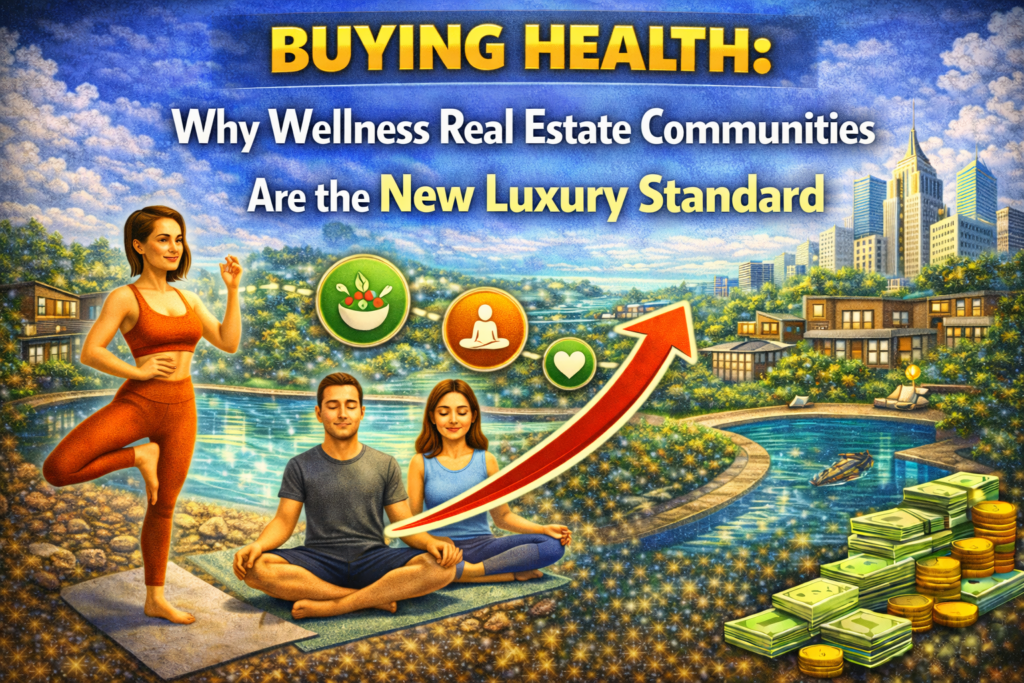
In a standard suburb, you have to drive to the gym. In Wellness Real Estate Communities, the environment tricks you into exercising. Sidewalks are wider. Staircases are placed prominently in the center of buildings (while elevators are tucked away) to encourage walking. Trails connect every backyard. You don’t have to “go” to work out; movement is baked into your daily routine.
The “Loneliness Epidemic” Factor
Here is a grim reality: Loneliness is as dangerous to your health as smoking 15 cigarettes a day. Post-2020, we are more isolated than ever. We work from home. We order groceries on an app. We binge-watch shows alone.
Wellness Real Estate Communities are attacking this problem head-on. They aren’t just selling houses; they are manufacturing “tribe.” I’ve seen developments that employ full-time “Lifestyle Directors” (basically cruise directors for neighborhoods) whose only job is to get neighbors talking. They organize sunset yoga, community harvest days, and cooking classes.
For a remote worker who just moved to a new city, this is invaluable. They are willing to pay a 20% premium on a condo just to guarantee they won’t be lonely. The social infrastructure is just as important as the physical infrastructure.Wellness Real Estate Communities
The Economics: Why the Premium Exists
Let’s talk numbers. Do Wellness Real Estate Communities actually hold their value? Short answer: Yes. Long answer: They are outperforming the broader market.
According to data from the Global Wellness Institute, homes in these communities typically command a price premium of 10% to 25% over comparable properties nearby. Why? Scarcity. There is a massive supply shortage of healthy homes. Most of America’s housing stock is old, leaky, and full of questionable materials. When a certified healthy home hits the market, it has no competition.
Furthermore, buyers view these homes as a defensive asset. You might cut back on vacations or fancy cars during a recession, but you are less likely to compromise on your health. This makes Wellness Real Estate Communities incredibly resilient during economic downturns.
Real-Life Buyer Profiles
Who is writing the checks for these places? It’s not just wealthy retirees.
- The Bio-Hacker Tech Bro: He wears an Oura ring, tracks his sleep, and wants his house to optimize his recovery. He loves the circadian lighting and the cold plunge pools.
- The Eco-Conscious Mom: She is worried about toxins. She wants non-toxic materials, zero-VOC paints, and a safe place for her kids to run free.
- The Active Boomer: They are retiring, but they refuse to sit in a rocking chair. They want to hike, swim, and garden to keep the doctor away.
The Certification Game: Avoiding “Well-Washing”
As Wellness Real Estate Communities become more popular, we are seeing a lot of marketing fluff. Putting a bowl of apples in the lobby does not make you a wellness building. This is called “Well-washing.”
To protect your investment, look for third-party verification. The gold standard is the WELL Certification or Fitwel. These aren’t easy to get. They require rigorous testing of air quality, water quality, and lighting performance. If a developer has gone through the trouble (and expense) of getting WELL Certified, you know they are serious.
Link to International WELL Building Institute: Understanding WELL
Is It Worth It?
I recently helped a client, “Marcus,” close on a townhome in one of these communities. The HOA fees were high—about $300 more per month than a standard neighborhood. Marcus did the math. “I’m canceling my gym membership ($150), I’m canceling my organic veggie delivery box ($100), and honestly, if this place keeps me out of the cardiologist’s office, it pays for itself.”
That is the logic driving this trend. We spend 90% of our lives indoors. Our homes determine our health outcomes more than our doctors do. Wellness Real Estate Communities are simply an acknowledgment of that fact.
Conclusion
The real estate market is evolving. The days of “bigger is better” are fading. We are entering the era of “healthier is better.” Wellness Real Estate Communities are not a fad; they are a correction. They are a return to a more natural, connected, and human way of living.
For investors, this is a sector with long-term tailwinds. For buyers, it’s a chance to live in a home that actively loves you back. So, the next time you are house hunting, don’t just look at the countertops. Take a deep breath. Ask about the air. Ask about the community. Because the ultimate luxury isn’t a gold faucet—it’s a long, healthy life.
Have you noticed any ‘Agrihoods’ popping up in your area? Drop a comment below—I’d love to hear if you’d trade a golf course view for a farm view!
FAQ Section
1. Are Wellness Real Estate Communities only for the wealthy? Currently, most are positioned in the luxury or “masstige” (mass prestige) sector due to the higher cost of sustainable building materials and technology. However, the trend is trickling down. We are starting to see affordable housing projects incorporate wellness principles like better ventilation and walkable designs.
2. Do these communities have age restrictions? Some do, but many are moving away from it. While the “55+ Active Adult” model was the precursor to this, modern Wellness Real Estate Communities are largely multi-generational. They recognize that mixing young families with seniors combats isolation for everyone.
3. What is the difference between a ‘Green’ community and a ‘Wellness’ community? A “Green” community focuses on the planet (energy efficiency, solar panels, carbon footprint). A “Wellness” community focuses on the person (air quality, mental health, social connection). The best Wellness Real Estate Communities are usually both, but the priority is human biology.
4. Do homes in these communities resell faster? Yes. Data suggests that homes with “healthy” features and certifications spend less time on the market. In a post-pandemic world, the assurance of clean air and a safe environment is a powerful motivator for buyers to move quickly.
5. Are the HOA fees significantly higher? They can be. Maintaining organic farms, high-tech air filtration systems in common areas, and paying for “Lifestyle Directors” costs money. You should expect to pay a premium on HOA dues, but residents often find it offsets other costs (gyms, food, entertainment).
6. Can I retrofit my current home to be a wellness home? Absolutely. You don’t have to move to benefit from this. You can install a whole-home water filter, upgrade your HVAC filters to MERV 13, switch to circadian LED bulbs, and use zero-VOC paints. You can create your own mini version of Wellness Real Estate Communities right where you are.