

Scared of contamination? Don’t be. Brownfield Land Investment offers massive ROI for investors brave enough to clean up the mess. Here is your roadmap to redevelopment riches.
Table of Contents
I drove past an old, abandoned gas station in my hometown every day for ten years. It was an eyesore—boarded-up windows, cracked concrete, and a chain-link fence covered in weeds. Everyone in town ignored it. They saw a liability.
Then, a developer from out of state bought it for pennies on the dollar. Six months later, the bulldozers arrived. Two years later? It’s a thriving boutique coffee shop with luxury apartments on top. That developer didn’t just see a dirty lot; he saw a Brownfield Land Investment opportunity that everyone else was too afraid to touch.
In the world of real estate, we often fight over “Greenfield” sites—pristine, untouched pastures ready for easy building. But let’s be honest: they aren’t making any more land, especially not in the city centers where people actually want to live. This scarcity has forced smart capital to look at the ugly ducklings of the property market.
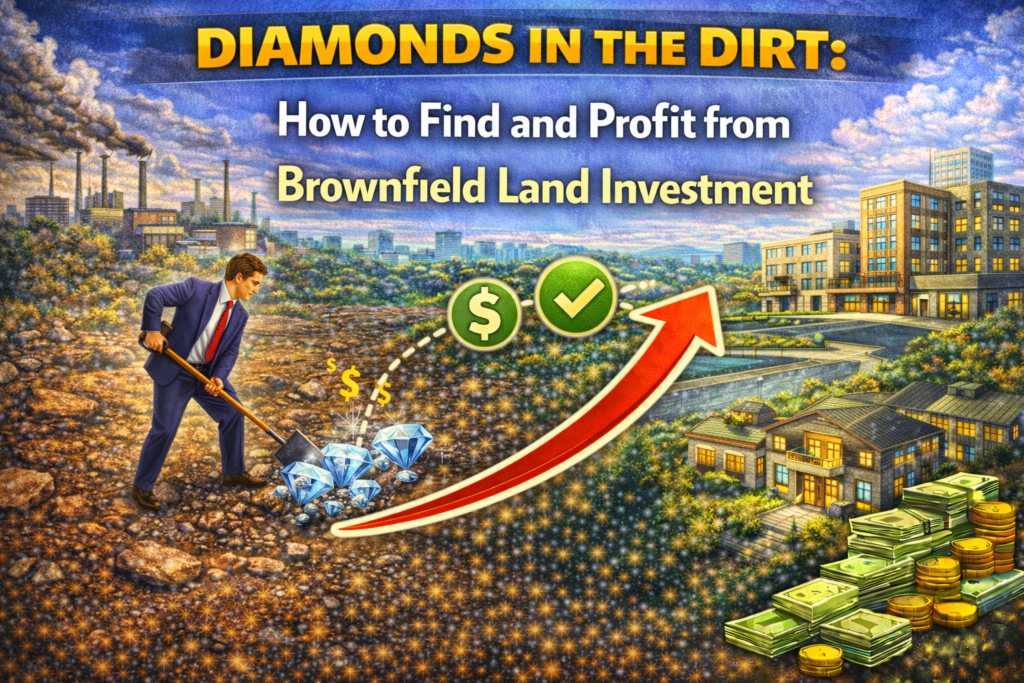
Brownfield Land Investment is the art of taking contaminated or previously used industrial land and scrubbing it clean for a new life. It is high-risk, high-reward, and incredibly complex. But if you have the stomach for it, the margins can be double or triple what you get from a standard deal. Let’s dig into the dirt and see how you can turn pollution into profit.
What Exactly is a Brownfield?
Before we talk money, we need to define the asset. A brownfield is a property where the expansion, redevelopment, or reuse may be complicated by the presence (or potential presence) of a hazardous substance, pollutant, or contaminant.
We aren’t just talking about nuclear waste sites. Common examples for Brownfield Land Investment include:
- Old Gas Stations: Leaking underground storage tanks (LUSTs).
- Dry Cleaners: Solvents often seep into the soil.
- Factories: Heavy metals or chemical residues.
- Auto Repair Shops: Oil and grease contamination.
The “Brownfield” label scares off 90% of buyers. They hear “contamination” and run. That fear is your friend. It drives the price down to rock bottom, allowing you to acquire prime real estate for a fraction of its clean value.
The “Prime Location” Advantage
Why bother cleaning up a mess? Because of where the mess is located. Most industrial history happened in the city center. That old textile mill isn’t in the suburbs; it’s right next to the downtown riverfront. That abandoned rail yard is three blocks from the financial district.
When you pursue Brownfield Land Investment, you are often acquiring land in locations that would be unaffordable if they were clean. You are buying A-class location for C-class prices. Once you remediate (clean) the site, you have a pristine lot in the heart of the city. The value jump is instantaneous.
The Due Diligence: Phase 1 and Phase 2
You cannot eyeball contamination. You need science. If you are serious about Brownfield Land Investment, you need to become best friends with Environmental Consultants.
1. Phase 1 Environmental Site Assessment (ESA): This is a paper trail investigation. The consultant looks at old maps, fire insurance records, and aerial photos to see what the land was used for. Did a dry cleaner operate there in 1960? If yes, you have a red flag. Cost: ~$2,000 – $4,000.
2. Phase 2 ESA: If Phase 1 finds risks, you go to Phase 2. This involves drilling. They take soil and groundwater samples and send them to a lab. This tells you exactly what chemicals are there and how deep they go. Cost: $10,000 – $50,000+.
Never, ever make an offer on a Brownfield Land Investment deal without a contingency clause for these tests. If the Phase 2 comes back with a $1 million cleanup bill on a $500k property, you need to be able to walk away.
Financing the Cleanup: Free Money Exists
This is the secret sauce. The government wants these sites cleaned up. They hate abandoned factories just as much as you do. Because of this, there are massive incentives available for Brownfield Land Investment.
- EPA Grants: The Environmental Protection Agency offers assessment grants and cleanup grants. You can sometimes get hundreds of thousands of dollars to pay for the remediation.
- Tax Credits: Many states offer “Voluntary Cleanup Programs” (VCP). If you enter the program and clean the site to their standards, they give you tax credits that can be sold or used to offset your income tax.
- Liability Protection: Once you complete the state VCP, you often get a “No Further Action” (NFA) letter. This legal document releases you from future liability for the old contamination. It effectively turns the “Brownfield” into a “Greenfield” in the eyes of the law.
Link to EPA: Brownfields and Land Revitalization
The Remediation Process: It’s Not Always Dig-and-Haul
When people think of cleanup, they imagine excavators digging up tons of dirt and trucking it to a landfill. That is called “Dig-and-Haul,” and it is the most expensive method. Modern Brownfield Land Investment uses smarter tech.
- Capping: Sometimes, you don’t need to remove the dirt. You just need to seal it. Putting a parking lot or a concrete building foundation over the contaminated soil “caps” it, preventing rain from washing the chemicals away and preventing people from touching it. This is often perfectly legal and safe for commercial use.
- Bioremediation: Injecting microbes (bugs) into the soil that eat the oil and turn it into harmless water and CO2.
- In-Situ Chemical Oxidation: Injecting chemicals into the ground to neutralize the pollutants.
By using these cheaper methods, you can lower your development costs significantly, boosting the ROI of your Brownfield Land Investment.
Risks: The “Unknown Unknowns”
I have to play devil’s advocate. This strategy can bankrupt you if you aren’t careful. The biggest risk in Brownfield Land Investment is finding something you didn’t expect. You budget $100k for cleanup. You start digging, and you find a buried oil tank that wasn’t on the maps. Suddenly, your cleanup cost is $300k.
You must have a fat contingency budget. If you are developing a standard site, maybe you keep 10% for reserves. On a brownfield, you want 20% or 30%. Also, financing is harder. Traditional banks are skittish about contamination. You might need to use hard money loans or private equity to fund the purchase and cleanup, then refinance into a conventional loan once the NFA letter is issued.
Real-Life Success: The “Industrial to Residential” Play
The hottest trend right now is converting old industrial zones into mixed-use residential neighborhoods. Look at the “Meatpacking District” in New York or the “Fulton Market” in Chicago. These were once gritty, dirty industrial hubs. Developers who saw the potential for Brownfield Land Investment early bought those warehouses for peanuts. Now, they are selling condos for millions.
You don’t have to be a billionaire to do this. Small investors can buy a single old auto body shop on the edge of a gentrifying neighborhood. Clean it up, get the NFA letter, and flip the land to a home builder. The builder pays a premium because the hard work (the environmental risk) is handled.
Link to CCIM Institute: Brownfield Redevelopment
Liability Transfer
One innovative tool in this space is “Environmental Insurance.” When you buy a Brownfield Land Investment, you can purchase a policy called “Pollution Legal Liability” (PLL). This protects you if the government comes back in 10 years and says, “Hey, you missed a spot.” It also protects you if the contamination migrates off-site to the neighbor’s property. Having this insurance makes lenders much more comfortable giving you a loan.
Conclusion
Brownfield Land Investment is not for the faint of heart. It requires patience, capital, and a tolerance for complexity. You are part real estate investor, part scientist, and part lawyer. But the rewards are unmatched. You are physically healing the earth while generating wealth. You are taking a blight on the community and turning it into an asset.
When you drive past that old gas station with the weeds, don’t look away. Look closer. There might be a gold mine buried under those cracked pavers, just waiting for someone with the vision to dig it out.
Have you ever considered buying a distressed commercial property? Let me know in the comments—are you team “Greenfield” or team “Brownfield”?
FAQ Section
1. Can I get a mortgage on a contaminated property? It is very difficult. Most traditional banks will not lend on a property with known contamination because the collateral is risky. For a Brownfield Land Investment, you typically need to use cash, seller financing, or specialized “bridge loans” to acquire and clean the site. Once it is clean, you can get a regular mortgage.
2. How long does the cleanup take? It varies. A simple soil removal might take a few weeks. A complex groundwater treatment using bioremediation can take 1 to 3 years of monitoring. You need to factor this “holding time” into your profit calculations because you’ll be paying property taxes and insurance while the land sits empty.
3. Is it safe to live on a former brownfield? Yes, if the remediation is done correctly. The state environmental agencies have strict standards for “residential use” vs “commercial use.” If you plan to build homes, you have to clean the soil to a much higher standard than if you plan to build a parking lot.
4. What if I find contamination after I buy it? If you didn’t do your due diligence (Phase 1 and 2), you own the mess. Under the “Superfund” law (CERCLA), the current owner is often responsible for the cleanup, even if they didn’t cause the pollution. This is why the Phase 1 assessment is non-negotiable for any Brownfield Land Investment.
5. Are grants available for private investors? Sometimes. While many EPA grants are targeted at non-profits or municipalities, private developers can often partner with the local city. The city applies for the grant to assess the land, and the developer pays for the cleanup. Check with your local economic development office.
6. Does the stigma of contamination linger? It can, but it fades quickly once new construction starts. Transparency is key. Being able to show the “No Further Action” letter and the clean soil reports to future buyers or tenants usually resolves any fears. In hot markets, location almost always trumps history.