
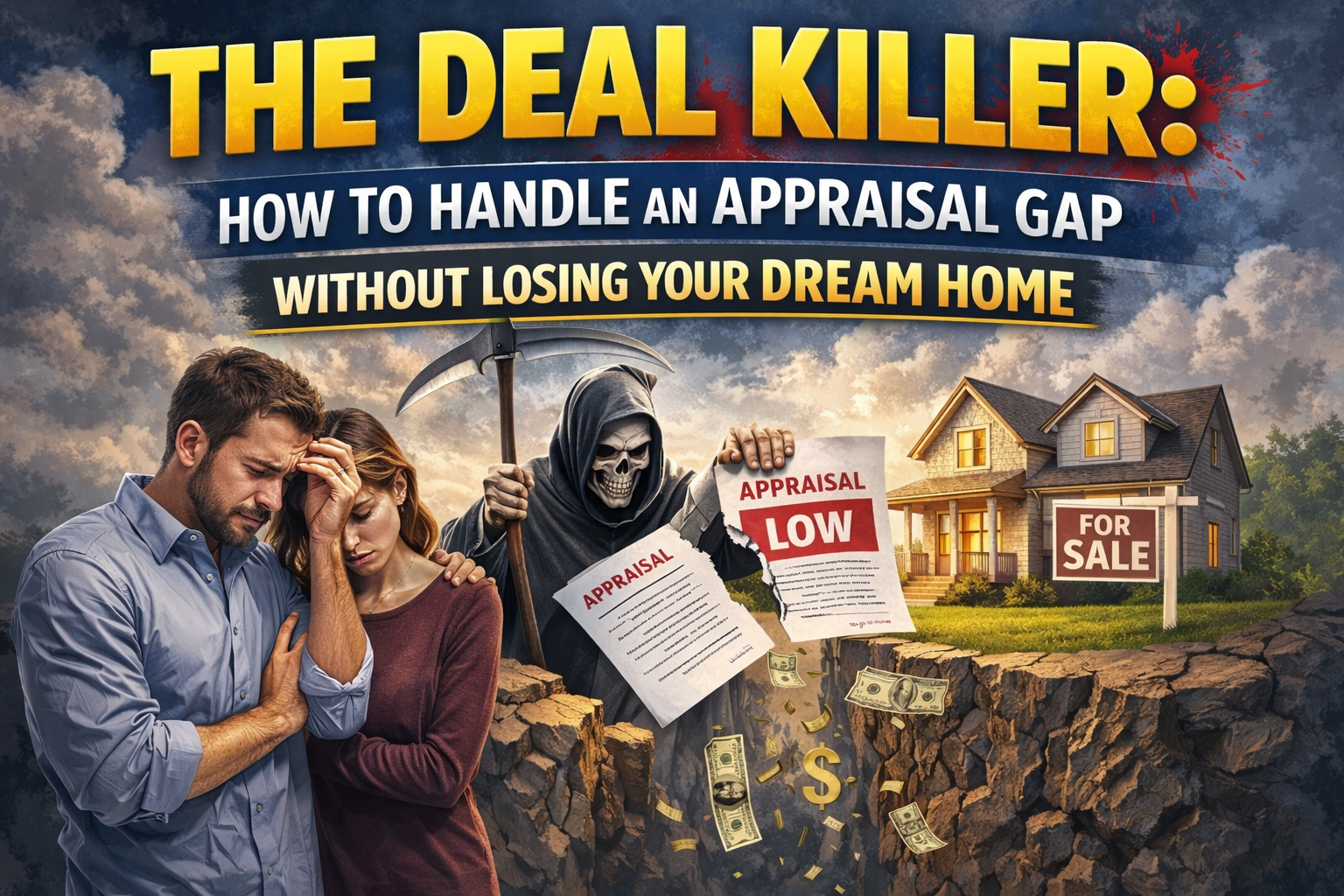
Worried about a low valuation? Don’t panic. We explain exactly what an Appraisal Gap is and 5 strategies to bridge the difference and save your deal.
Table of Contents
I was sitting in my car last Tuesday, staring at the steering wheel, dreading the phone call I had to make. My buyers, a sweet young couple named “Ben and Sarah,” had finally—after six rejected offers—gotten a contract on a charming bungalow. They went $25,000 over asking price to beat out four other bidders. They were picking out paint colors.
Then the email from the lender popped up: “Value came in low.”
The house appraised for the list price, not the contract price. We were short $25,000. This is the moment where dreams usually die. In a scorching hot real estate market, the Appraisal Gap is the silent deal killer that nobody talks about until it smacks them in the face. It turns excitement into panic in the blink of an eye.
If you are buying in a competitive market, you need to understand this beast before you write an offer. If you don’t, you risk losing your earnest money or, worse, the house itself. Let’s break down the mechanics of an Appraisal Gap, why it’s happening so frequently, and the specific moves you can make to keep the deal alive.
What on Earth is an Appraisal Gap?
Let’s keep it simple. When you buy a house with a mortgage, the bank hires a third-party appraiser to tell them what the house is worth. The bank isn’t going to lend you $500,000 for a house that is only worth $400,000. They need to protect their collateral.
An Appraisal Gap occurs when your offer price is higher than the appraiser’s opinion of value.
The Math:
- List Price: $400,000
- Your Offer: $450,000 (You really wanted it!)
- Appraised Value: $430,000
The Result: You have a $20,000 Appraisal Gap. The lender will only base the loan on the $430,000 value. That extra $20,000? That’s now a hole in the deal that needs to be filled.
Why Is This Happening Everywhere?
You might be thinking, “If I’m willing to pay $450,000, isn’t that what it’s worth?” To you? Yes. To the bank? No.
Appraisers look backward. They look at “comparable sales” (comps)—houses that sold in the neighborhood over the last 3 to 6 months. In a rapidly rising market, prices jump week by week. The data from three months ago is “old news.” It reflects lower prices. So, when you offer today’s inflated price, the historical data hasn’t caught up yet. This lag creates the Appraisal Gap. It is a symptom of a market moving faster than the paperwork can keep up.
Strategy 1: The “Cash Bridge” (The Painful Way)
The cleanest, fastest, and most painful way to fix an Appraisal Gap is to simply pay the difference in cash. In our example above, Ben and Sarah would need to bring their original down payment plus an extra $20,000 to the closing table.
This hurts. It drains your emergency fund or furniture budget. But in a seller’s market, this is often what is required. If you have the liquidity, this solves the problem instantly. The seller gets their price, the bank gets their safe loan-to-value ratio, and you get the keys.
Strategy 2: The Negotiation (Meeting in the Middle)
If you don’t have an extra $20k lying around, we have to go back to the seller. We can ask them to lower the sales price to match the appraisal. In a balanced market, sellers often agree to this. But in a hot seller’s market? Good luck. If they have backup offers, they might just tell you to take a hike.
However, a compromise often works. We might say, “Hey, we have an Appraisal Gap of $20,000. We can cover $10,000 cash if you drop the price by $10,000.” It spreads the pain. The seller takes a small haircut, and the buyer digs a little deeper. It saves the deal without crushing either party.
Link to Bankrate: What to do when the home appraisal is lower than the offer
Strategy 3: The Rebuttal (The Hail Mary)
You can challenge the appraisal. This is called a “Reconsideration of Value.” Your real estate agent (that’s me) will dig up better comps that the appraiser might have missed. “Hey, you used the house on the busy road; you should have used this one on the quiet cul-de-sac that sold yesterday.”
I have to be honest with you: This rarely works. Appraisers are stubborn. They are licensed professionals who defend their work. Unless there is a glaring factual error (like they said it was 3 bedrooms but it’s actually 4), getting them to wipe away a significant Appraisal Gap is a long shot. Try it, but don’t bank on it.
Strategy 4: Shifting the Financing
This is a ninja move that many buyers forget about. If you were planning to put 20% down, you have wiggle room. Let’s say you have that $20,000 Appraisal Gap. Instead of bringing extra cash, you can shift your down payment cash to cover the gap.
You take $20,000 out of your down payment bucket to fill the gap. Now, instead of putting 20% down, maybe you are putting 15% down on the loan.
- The Downside: You might have to pay PMI (Private Mortgage Insurance).
- The Upside: You don’t need to find new money. You get the house. PMI is often relatively cheap (maybe $80/month for a few years). Losing the house is expensive. It’s often a smart trade.
The “Appraisal Gap Coverage” Clause
Here is how we won the house for Ben and Sarah in the end. We planned for this before we wrote the offer. We included an Appraisal Gap guarantee clause.
It read something like this: “Buyer agrees to pay up to $15,000 above the appraised value, not to exceed the contract price.”
This told the seller upfront: “We know the appraisal might be low, and we promise not to use it as an excuse to haggle with you.” Sellers love this. It reduces their risk. By capping our liability at $15,000, Ben and Sarah knew their worst-case scenario, and the seller knew the deal was solid.
If you are bidding in a competitive market, adding an Appraisal Gap coverage clause is one of the strongest ways to get your offer accepted over the competition.
Link to Rocket Mortgage: Understanding the Appraisal Gap Clause
When to Walk Away
Sometimes, the gap is just too wide. If the Appraisal Gap comes in at $50,000 or $70,000, you have to ask yourself a hard question: Am I overpaying? The appraisal is a safety mechanism. It’s a reality check. If the bank tells you the house is wildly overpriced, and the seller refuses to budge, walking away is a valid strategy.
Most contracts have an “Appraisal Contingency.” If you can’t come to an agreement, this contingency allows you to back out and get your earnest money deposit returned. Don’t be afraid to use it. There will be other houses.
Conclusion
The Appraisal Gap is a frustrating, stressful, and expensive hurdle. But it is also a sign that you are buying a desirable asset in a growing market. The key is not to be blindsided by it. Talk to your lender about your options before you bid. Keep some cash in reserve. And rely on your agent to negotiate the middle ground.
Ben and Sarah? They covered the gap using the financing shift method. They paid a little PMI for two years, refinanced when the value went up, and now they are sitting on $100,000 of equity. The stress of that Tuesday phone call is a distant memory.
Have you ever had a deal threatened by a low appraisal? Tell me how you solved it in the comments below!
FAQ Section
1. Can I switch lenders to get a new appraisal? Yes, you can, but it’s risky. A new lender will order a new appraisal, which might come in higher and eliminate the Appraisal Gap. However, it might also come in lower. Plus, starting over with a new lender takes time (2-3 weeks), and the seller might not be willing to wait that long.
2. Does the seller ever lower the price? Absolutely. In a buyer’s market or a balanced market, the seller almost always lowers the price to the appraised value because they know the next buyer will have the same problem. It is only in a crazy seller’s market that they refuse to budge.
3. Is an Appraisal Gap the same as a low down payment? No. The down payment is your equity in the loan. The Appraisal Gap is the difference between price and value. However, the cash you use for a down payment can be repurposed to cover the gap if your lender structures the loan creatively.
4. Can I get a second opinion on the appraisal? Not exactly. You can submit a “Reconsideration of Value” (ROV) to the original appraiser with new data. Lenders rarely order a second full appraisal unless there is proof of gross negligence or bias by the first appraiser.
5. Who gets the appraisal report? You do (the buyer). You paid for it. The lender gets a copy. The seller does not see it unless you choose to share it with them to prove the low value during negotiations.
6. Does an appraisal gap affect my interest rate? Indirectly, yes. If you use your cash to cover the Appraisal Gap and end up putting less money down on the loan (e.g., going from 20% down to 10% down), your Loan-to-Value (LTV) ratio changes. A higher LTV might trigger a slightly higher interest rate or require mortgage insurance.
