

Tired of unexpected repairs? Digital Twins in Real Estate are the crystal ball landlords have been waiting for. See how this tech predicts problems before they break.
Table of Contents
I was standing in the boiler room of a 40-story Manhattan office tower last winter with a facility manager named “Frank.” Frank looked like he hadn’t slept in a week.
“The HVAC system is acting up again,” he grumbled, wiping grease off his hands. “I have no idea which valve is sticking, so we have to shut down the whole cooling tower to find it.”
“Frank,” I said, looking at the mess of pipes, “Why don’t you just ask the twin?”
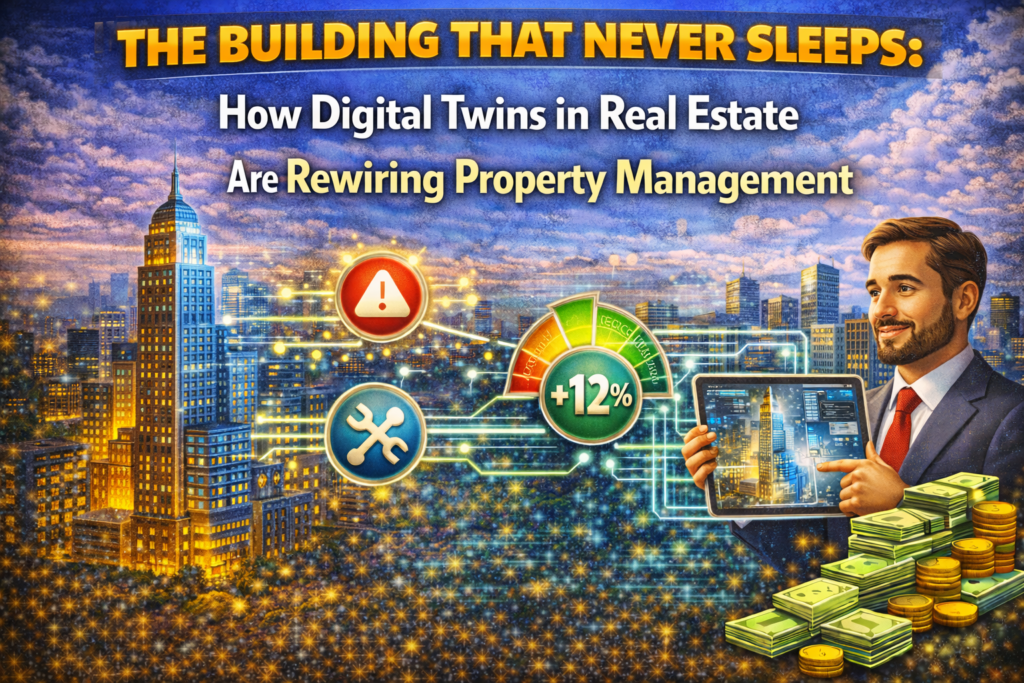
He looked at me like I was crazy. But six months later, after the building owners invested in a full digital retrofit, Frank’s life changed. He no longer hunts for leaks with a flashlight. He sits in an office, looks at a 3D model on his screen, and clicks on a red dot that tells him exactly which valve is failing, why it’s failing, and what part he needs to fix it.
This is the promise of Digital Twins in Real Estate. It sounds like sci-fi, but it is rapidly becoming the standard for modern property management. We are moving from a world where we fix things after they break to a world where we fix them before they even wobble.
If you manage a portfolio—whether it’s a skyscraper or a string of apartment complexes—ignoring this tech is like refusing to use email. It’s inefficient, it’s expensive, and frankly, it’s obsolete. Let’s decode what Digital Twins in Real Estate actually are and how they are saving owners millions in operational costs.
What is a “Digital Twin” Anyway?
Forget the buzzwords for a second. A digital twin is simply a virtual replica of a physical building. But it’s not just a pretty 3D picture. It is a “living” model connected to the real building via sensors (the Internet of Things, or IoT).
Think of it like Google Maps for your building’s insides.
- The Static Data: The blueprints, the layout, the location of every pipe and wire.
- The Live Data: Real-time feedback from sensors. How hot is the boiler? How much water is flowing through the main line? Is the lobby elevator vibrating too much?
When you combine these, you get Digital Twins in Real Estate. You get a dashboard that pulses with the heartbeat of your property. You can see the health of your asset in real-time without ever leaving your desk.
Predictive Maintenance: The End of the 3 AM Call
The biggest nightmare for any property manager is the emergency repair. A pipe bursts at 3 AM. An elevator gets stuck with tenants inside. These emergencies cost a fortune because you are paying for rush labor and parts.
Digital Twins in Real Estate shift the game from “Reactive” to “Predictive.” Because the twin is constantly analyzing data, it spots anomalies that a human would miss. For example, the twin might notice that the vibration on the rooftop AC unit has increased by 2% over the last week. It’s not broken yet, but the data says a bearing is about to fail. The system sends an alert: “Replace Bearing X within 5 days.”
You schedule the repair for Tuesday afternoon. The part is ordered. The tenants never lose AC. No overtime pay. No angry emails. This predictive capability is the single biggest ROI factor for Digital Twins in Real Estate.
Energy Efficiency: Finding the “Phantom” Waste
I once worked with a commercial building that was bleeding money on electricity. The owners couldn’t figure it out. They had LED lights. They had new windows. We deployed a digital twin pilot program. Within 48 hours, the twin found the problem.
The building management system (BMS) was fighting itself. On the 12th floor, the heating was running at full blast while the AC was also running to cool it down. A faulty sensor had tricked the system. Humans didn’t catch it because the temperature felt fine. But the Digital Twins in Real Estate software saw the energy spike immediately.
By fixing that one conflict, they saved $15,000 a year. In a world where ESG (Environmental, Social, and Governance) mandates are getting stricter, having a tool that hunts down energy waste is invaluable. It boosts your Net Operating Income (NOI) directly.
Link to Forbes: How Digital Twins Are Revolutionizing Real Estate
The “Virtual Walkthrough” for Remote Management
If you manage properties across different cities, you know the pain of travel. “I need to see the condition of the lobby in the Chicago building.” That used to mean a flight.
With Digital Twins in Real Estate, you can walk through the Chicago lobby from your office in Miami. And because the twin can be integrated with 360-degree cameras and maintenance logs, you aren’t just seeing a static photo. You can click on the wall and see when it was last painted. You can click on the fire extinguisher and see when it expires.
For large institutional investors, this centralized command center is a game-changer. It allows one asset manager to oversee 50 buildings with the same level of detail as someone who is on-site.
Construction and Renovation: Measure Twice, Cut Zero Times
Renovations are where budgets go to die. “Oh, we didn’t know there was a structural beam behind that wall.” Change order. $10,000. “We didn’t realize the ductwork wouldn’t fit in this ceiling.” Change order. $5,000.
Digital Twins in Real Estate eliminate the guesswork. Before you swing a single hammer, you can simulate the renovation in the twin. You can see exactly where the clash points are. You can drag and drop new layouts to see how they impact the airflow or the lighting. By building it virtually first, you solve the problems on a screen (which is free) rather than on the job site (which is expensive).
Tenant Experience: The “Uber-ization” of Buildings
Tenants today expect their building to be smart. They want an app for everything. Digital Twins in Real Estate can feed data directly to tenant apps.
- Comfort: A tenant complains it’s too hot. Instead of sending a guy with a thermometer, the twin verifies the temp instantly and adjusts the damper automatically.
- Space Usage: For office tenants, the twin can use occupancy sensors to show them how their employees are actually using the space. “Hey, nobody uses Conference Room B on Fridays. Let’s turn off the AC in there to save money.”
This level of transparency builds trust. It makes the tenant feel like a partner in the building’s operation, not just a rent check.
Link to JLL: The Future of Digital Twins in Built Environment
The Barrier to Entry: Cost and Complexity
Okay, let’s be real. If Digital Twins in Real Estate are so great, why doesn’t every duplex have one? Cost. Creating a high-fidelity digital twin requires laser scanning the building (LiDAR), installing sensors, and integrating complex software. For a Class A office tower, the ROI is obvious. For a 4-unit apartment building? Probably not yet.
However, the tech is getting cheaper. “Light” versions of digital twins—using simple 360 cameras and basic IoT sensors—are becoming affordable for mid-market portfolios. Just like smartphones started as luxury items and are now everywhere, Digital Twins in Real Estate are trickling down from skyscrapers to strip malls.
Data Overload: The “Noise” Problem
There is a risk of having too much data. If your phone buzzed every time a lightbulb flickered, you would throw it out the window. Implementation is key. You need a system that filters the noise. You don’t want to know everything; you want to know what matters. Successful adoption of Digital Twins in Real Estate relies on setting the right “thresholds” for alerts. You need actionable intelligence, not just a sea of numbers.
Conclusion
We are witnessing the digitization of the physical world. The building of the future isn’t just concrete and glass; it is code and data. Digital Twins in Real Estate are the bridge between the two.
For Frank the facility manager, it means he gets to go home on time. For the owner, it means higher margins and a higher asset value. For the tenant, it means a building that actually works.
If you are still managing your properties with a clipboard and a prayer, it’s time to look at the virtual alternative. The twin is ready to go to work.
Have you used any smart building tech in your rentals? Let me know in the comments—did it save you money or just give you a headache?
FAQ Section
1. How much does a Digital Twin cost? It varies wildly based on size and complexity. For a large commercial building, it can cost between $0.50 and $1.50 per square foot to set up the initial scan and model, plus a monthly SaaS (Software as a Service) fee for the platform. For smaller properties, simpler “virtual tour” style twins are much cheaper.
2. Is a Digital Twin the same as BIM? Not exactly. BIM (Building Information Modeling) is used during construction and design. It is usually a static file. Digital Twins in Real Estate take that BIM model and connect it to live data sensors for the ongoing operation of the building. BIM is the skeleton; the Digital Twin is the living body.
3. Do I need new sensors for this to work? Often, yes. While some modern buildings have “smart” systems (BMS) that can feed data to the twin, older buildings usually need a “retrofit” of IoT sensors to track things like temperature, occupancy, and energy usage.
4. Is this only for commercial buildings? Currently, the adoption is 90% commercial and industrial. However, high-end luxury residential estates and large multifamily complexes are starting to adopt Digital Twins in Real Estate to manage complex HVAC and security systems.
5. Can it help with insurance? Yes! Insurance companies love data. If you can prove via your digital twin that you have a predictive maintenance program and your fire systems are monitored 24/7, you can often negotiate lower premiums because you are a lower risk.
6. Is my data secure? Cybersecurity is a massive concern. If someone hacks your digital twin, they could theoretically unlock doors or shut down the AC. Reputable providers of Digital Twins in Real Estate use enterprise-grade encryption. It is critical to treat your building’s data with the same security protocols as your bank account.
