
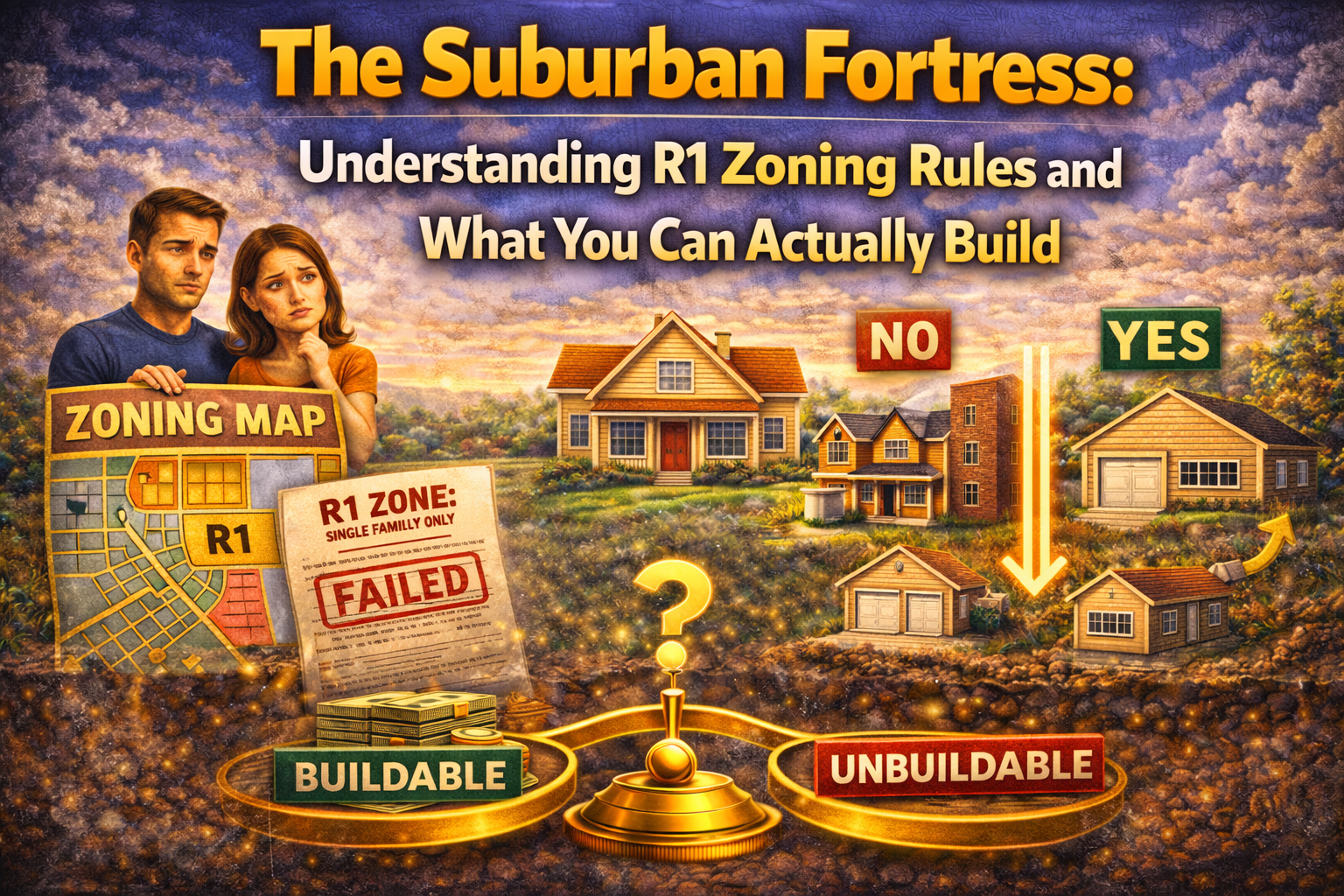
Dreaming of a backyard cottage or a home business? Before you dig, you need to understand R1 Zoning. We break down the strict rules of single-family living.
I recently had a consultation with an ambitious young investor named “Tyler.” He had just purchased a large, corner lot in a quiet neighborhood with a modest ranch-style house on it. His plan was brilliant on paper: knock down the garage, build a duplex for rental income, and run a small coffee roasting business out of the basement.
Table of Contents
“It’s my land,” Tyler argued. “I can do what I want.”
I had to be the one to burst his bubble. “Tyler,” I said, pulling up the county map, “You are in an R1 Zoning district. You can’t build a duplex. You can’t sell coffee. You can barely build a shed without a permit.”
Tyler’s face dropped. He had fallen into the trap that catches so many homeowners and rookie investors. He assumed land ownership meant total freedom. But in the United States, your freedom is defined by a color-coded map at city hall. And if your plot is colored yellow—the standard color for R1 zoning—your options are strictly limited.
Whether you are looking to build an in-law suite, start a home business, or just put up a tall fence, you need to speak the language of zoning. Let’s decode the rules of the most common residential classification in America and see exactly what you can (and definitely cannot) do.
What Exactly Is R1 Zoning?
In the alphabet soup of city planning, “R” stands for Residential. The “1” stands for the number of families allowed per dwelling unit. Put them together, and R1 zoning translates to Single-Family Residential.
This is the bread and butter of the American suburbs. It is designed to create low-density, quiet neighborhoods. The goal of urban planners here is to prevent overcrowding and maintain a specific “character.” They don’t want a towering apartment complex blocking the sun for a bungalow, and they don’t want a busy retail store creating traffic on a cul-de-sac.
When you buy a property with an R1 zoning designation, you are essentially signing a contract with the city that says, “I promise to use this land for one house, for one family.”
The “One House” Rule (and the ADU Loophole)
The most defining characteristic of R1 zoning is density. Historically, this meant you could have exactly one main structure with one kitchen. If you wanted to turn your basement into a separate apartment with a stove and a private entrance to rent out on Airbnb? Illegal. If you wanted to build a second small house in the backyard for your mom? Illegal.
However, the times are changing. Due to the housing crisis, many states (like California, Oregon, and Washington) and cities are effectively banning strict R1 zoning by passing laws that allow Accessory Dwelling Units (ADUs). An ADU is a secondary structure—a “granny flat” or a converted garage—that sits on the same lot.
While the base layer of R1 zoning still prohibits a full-blown duplex (two equal units sold separately), the ADU revolution is creating a grey area. You can now often build a second unit, provided it is smaller than the main house and (usually) shares utility connections. Always check your local ADU ordinance before pouring concrete.

The Invisible Box: Setbacks and Height Limits
Even if you are just building a single-family home, R1 zoning puts you in an invisible box. You cannot just build to the edge of your property line.
1. Setbacks: Every R1 lot has “setback” requirements.
- Front Yard: You might have to keep your house 20 feet back from the sidewalk.
- Side Yard: You usually need 5 to 10 feet of clearance from the neighbor’s fence.
- Rear Yard: Often requires 15 to 25 feet of green space.
I’ve seen deals fall apart because a buyer wanted to expand a kitchen, only to find out the existing house was already sitting on the setback line. In strict R1 zoning areas, you can’t extend that wall even one inch.
2. Height Restrictions: R1 neighborhoods value privacy. They don’t want you looking down into your neighbor’s pool. Consequently, most R1 zoning codes cap building height at 30 or 35 feet (basically two stories). If you dream of a three-story tower with a roof deck, you are likely in the wrong zone.
The “Lot Coverage” Ratio
This is the sneaky rule that catches people who buy small lots. R1 zoning often dictates a “Maximum Lot Coverage” percentage, usually around 30% to 50%.
If you have a 10,000-square-foot lot and a 40% coverage limit, the footprint of all your structures (house, garage, shed, gazebo) cannot exceed 4,000 square feet. This ensures the neighborhood stays “green” and doesn’t become a concrete jungle. If you plan to pave your entire backyard for a tennis court, the lot coverage rules in an R1 zoning district will likely stop you cold.
Link to Investopedia: Zoning Ordinances Explained
Running a Business from Home
Let’s go back to Tyler and his coffee roasting idea. Can you work from home in an R1 zone? Yes, but with major caveats.
R1 zoning usually allows for “Home Occupations,” but they must be invisible to the street.
- Allowed: A freelance graphic designer working on a laptop. A writer. An accountant who does everything virtually.
- Prohibited: Anything that increases traffic, noise, or smells.
You cannot open a hair salon where clients are parking in the driveway all day. You cannot run a welding shop in the garage that makes noise at 7 AM. And you certainly can’t run an industrial coffee roaster that vents smoke into the neighbor’s window. If your business has employees showing up to your house or customers knocking on the door, you are violating R1 zoning rules. The neighbors will call code enforcement, and you will be shut down.
Can You Keep Chickens? (The Lifestyle Rules)
Zoning isn’t just about buildings; it’s about usage. The urban farming trend has clashed heavily with R1 zoning restrictions. While some progressive cities now allow a small flock of hens (no roosters—too loud!), many traditional suburban codes still classify chickens as “livestock” or “farm animals,” which are banned in residential zones.
The same goes for storing boats or RVs. Many R1 zoning codes prohibit parking a boat in your driveway for more than 48 hours. They want it hidden in a garage or moved to a storage facility. If you have a 30-foot Winnebago, check the local ordinances before you buy the house, or you might be paying storage fees forever.
Breaking the Rules: The Variance
Is it ever possible to bend the rules? Yes, through a process called a Variance. If your lot is oddly shaped (like a pizza slice) or has a giant rock formation that makes following the setback rules impossible, you can petition the city for relief.
However, do not bank on this. Getting a variance in an R1 zoning district is difficult. You have to prove “hardship.”
- Valid Hardship: “The steep slope of the land makes it physically impossible to build 20 feet back.”
- Invalid Hardship: “I want a bigger living room.”
You will have to stand in front of a zoning board and your neighbors will be invited to object. If you are trying to break the core tenets of R1 zoning (like density or height), the answer is almost always no.
Link to Nolo: Residential Zoning Classifications
Spot Zoning and Future Changes
Zoning isn’t static. It changes. Sometimes, a developer will buy a large R1 tract and petition to have it rezoned to R2 (duplex) or R3 (multi-family) to build condos. This is called “upzoning.”
Conversely, there is “Spot Zoning,” where a specific parcel is treated differently than the surrounding area. This is controversial and often illegal, but it happens. If you are buying a home next to a vacant lot, investigate the zoning of that empty land. Just because your house is R1 zoning doesn’t mean the empty field next door isn’t zoned Commercial. You could wake up in five years with a Walmart loading dock as your new neighbor.
Conclusion
R1 zoning is a double-edged sword. On one hand, it protects your property value. It ensures that a factory won’t open next door and that your street remains quiet and safe for kids to ride bikes. It creates stability. On the other hand, it restricts your freedom. It limits your ability to monetize your land or expand your home exactly how you wish.
Before you make an offer on a home, don’t just look at the granite countertops. Look at the zoning map. Understand the invisible lines that surround the property. Because in real estate, the government is always your silent partner, and in an R1 zoning district, that partner likes things quiet, uniform, and predictable.
Have you ever tried to get a variance for a renovation? Tell me your story in the comments—did the zoning board show mercy, or did they shut you down?
FAQ Section
1. What is the difference between R1 and R2 zoning? The primary difference is density. R1 zoning is strictly for Single-Family residences (one unit). R2 zoning typically allows for Two-Family residences, meaning you can build a duplex or a semi-detached home on the lot. R2 offers more flexibility for investors looking for rental income.
2. Can I run an Airbnb in R1 zoning? It depends on the city. Some cities treat short-term rentals (STRs) as a commercial business (like a hotel) and ban them in R1 zones. Others allow them but require a permit and occupancy taxes. Never assume you can Airbnb a property without checking the local STR ordinance first.
3. Does R1 zoning apply to the countryside? Usually, rural areas use different codes like “Agricultural” (A1) or “Rural Residential” (RR). These zones often have much larger lot requirements (e.g., minimum 5 acres) but allow for more freedom regarding livestock and outbuildings compared to suburban R1 zoning.
4. Can I build a shed in my backyard in R1? Yes, usually. However, it still has to respect setbacks. You typically can’t build a shed right against the neighbor’s fence. Also, if the shed is over a certain size (often 120 square feet), you will likely need a building permit even in an R1 zoning area.
5. Why are R1 lots so expensive? Scarcity and demand. Most American families want the “detached home with a yard” lifestyle. Because R1 zoning requires larger lots for fewer people (low density), the land cost per unit is higher than in high-density zones like condos or apartments.
6. Where can I find the zoning for a specific property? Most counties and cities have GIS (Geographic Information System) maps available online for free. Search “[Your County] GIS map,” enter the address, and look for the zoning layer. It will clearly label the parcel, usually with a color code (yellow is common for R1 zoning).
